What's new in the Analytics for 8x8 Work July 2026 release?
The July 2026 release of Analytics for 8x8 Workincludes the following new features and enhancements:
- Device Status dashboard improvements
- Active Calls report now shows simultaneous Ring Group alerting
- Run scheduled reports across all your PBXs at once
- Ability to grant users access to a data subset based on their roles and permissions (Beta)
Device Status dashboard improvements
The Device Status dashboard provides near real-time visibility into endpoint registration status in your 8x8 cloud phone system. You can monitor connectivity, detect service issues, and take action before problems affect users or call center performance.
The Device Status dashboard includes three updates:
- Redesigned site endpoint status chart
- Updated endpoint status signal documentation
- Automatic data refresh
Redesigned site endpoint status chart
Spot and prioritize site problems faster. The site endpoints status chart has been redesigned with a severity-tier summary that groups sites by impact level. You no longer need to scroll through unaffected sites to find issues.
As part of this change, the standalone Overall endpoint status statistics chart has been removed. The information it previously provided is now consolidated into the redesigned site endpoint status chart.
To learn more, see Site endpoint status chart.

Updated endpoint status signal documentation
Endpoint status now shows whether a device is registered on the network, not its live activity. This is a registration-based signal, not a real-time presence signal. The distinction matters when you are troubleshooting or interpreting status data for reporting purposes.
To learn more, see How endpoint status is determined.
Automatic data refresh
The Device Status dashboard now refreshes automatically every 60 seconds. You no longer need to reload the page to see current endpoint data.
To learn more, see Refresh data and timing expectations.
Active Calls report now shows simultaneous Ring Group alerting
You can now see how calls are distributed across Ring Group agents in real time using the Active Calls dashboard.
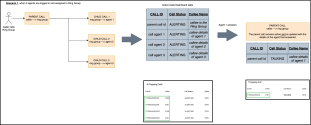
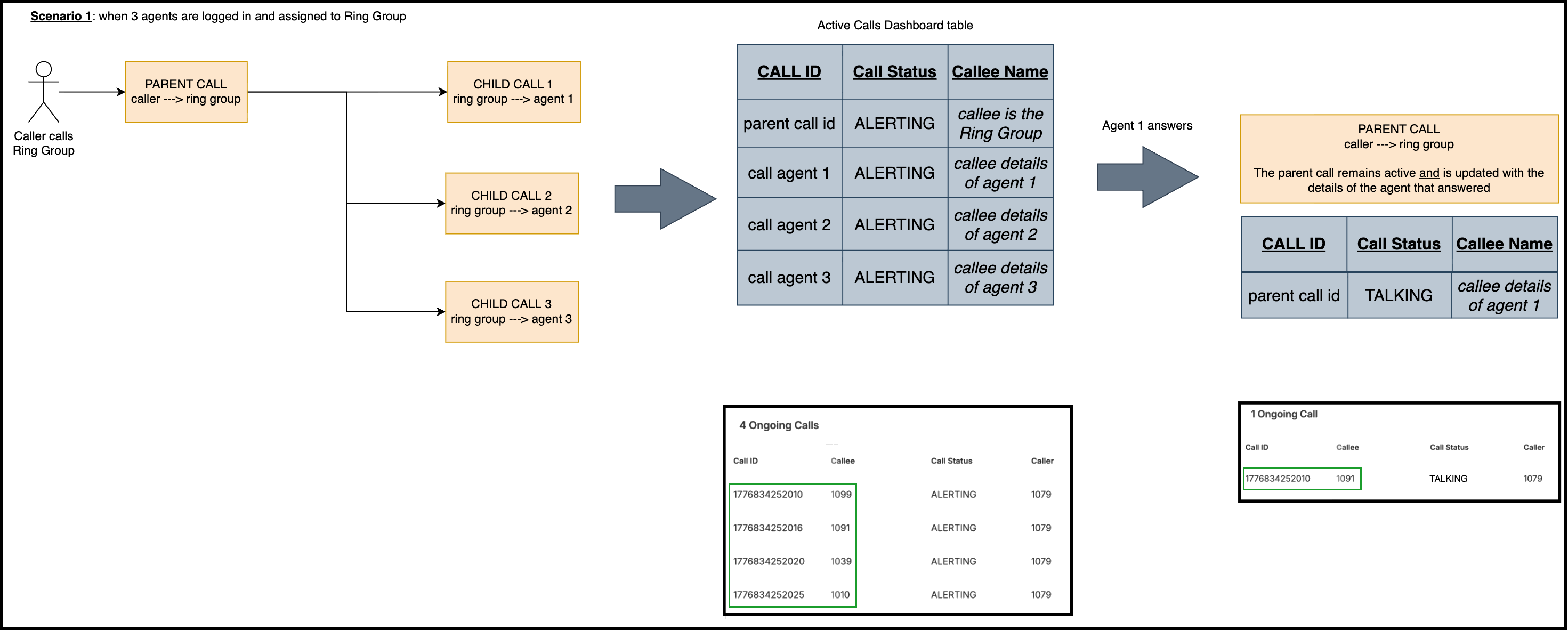
When an administrator configures simultaneous alerting, the Active Calls dashboard shows each alerted agent on its own row with its own Call ID. Once an agent answers, the report consolidates to a single row and updates to show that agent's name and extension.
This makes it easier to monitor Ring Group activity as it happens, including how calls fork, which agent answered, and how missed alerts are handled.
What you'll see
-
When a call enters a Ring Group with available agents. The Active Calls dashboard displays one parent call row and one child call row per alerted agent, each with an Alerting status. When an agent answers, the report updates to a single Talking row. Unanswered child calls are marked as missed and removed.
-
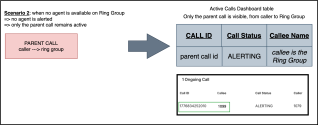
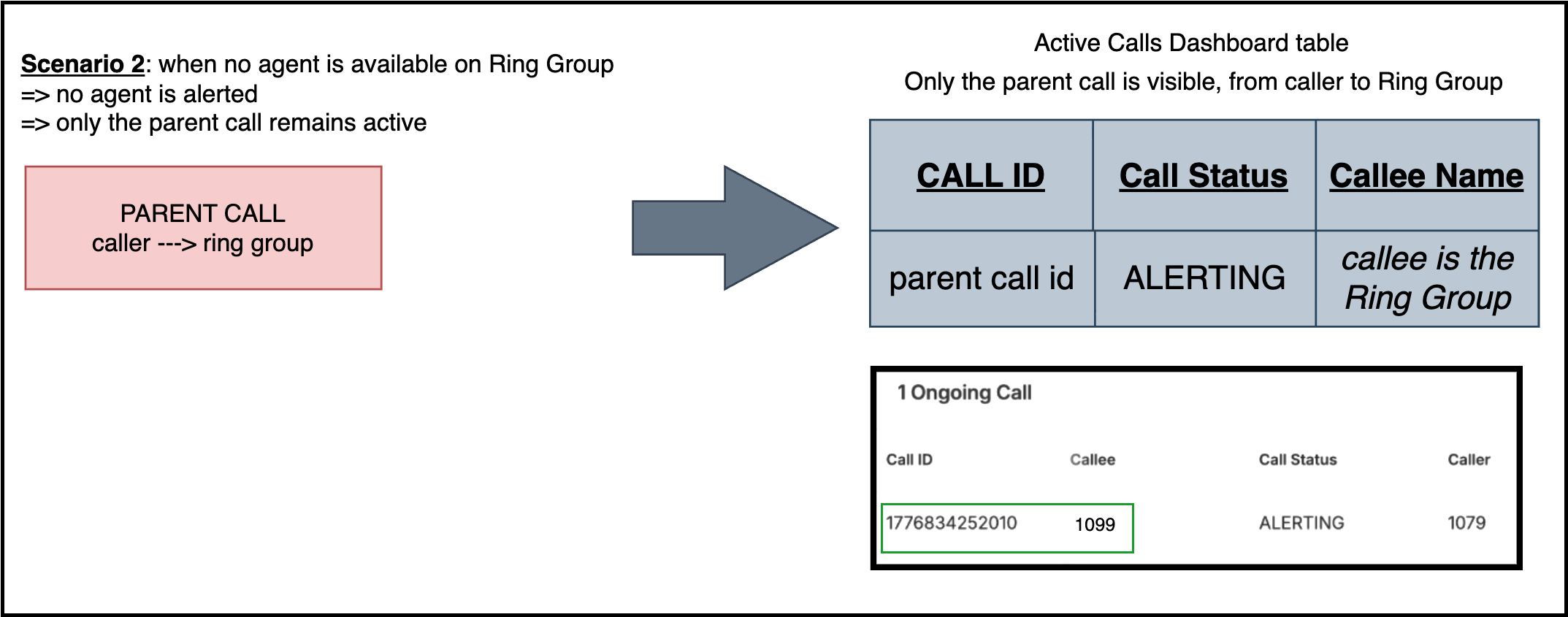
When no agents are available: The report displays only the parent call row with an Alerting status.
Where to find it
In 8x8 Work, go to Call Report > Active Calls.
To learn more, see Run the Active Calls Dashboard.
Run scheduled reports across all your PBXs at once
Organizations managing multiple PBXs can now generate a single scheduled report across all their systems, instead of running a separate report for each PBX Private Branch Exchange—a private telephone network used within a company..
What's new
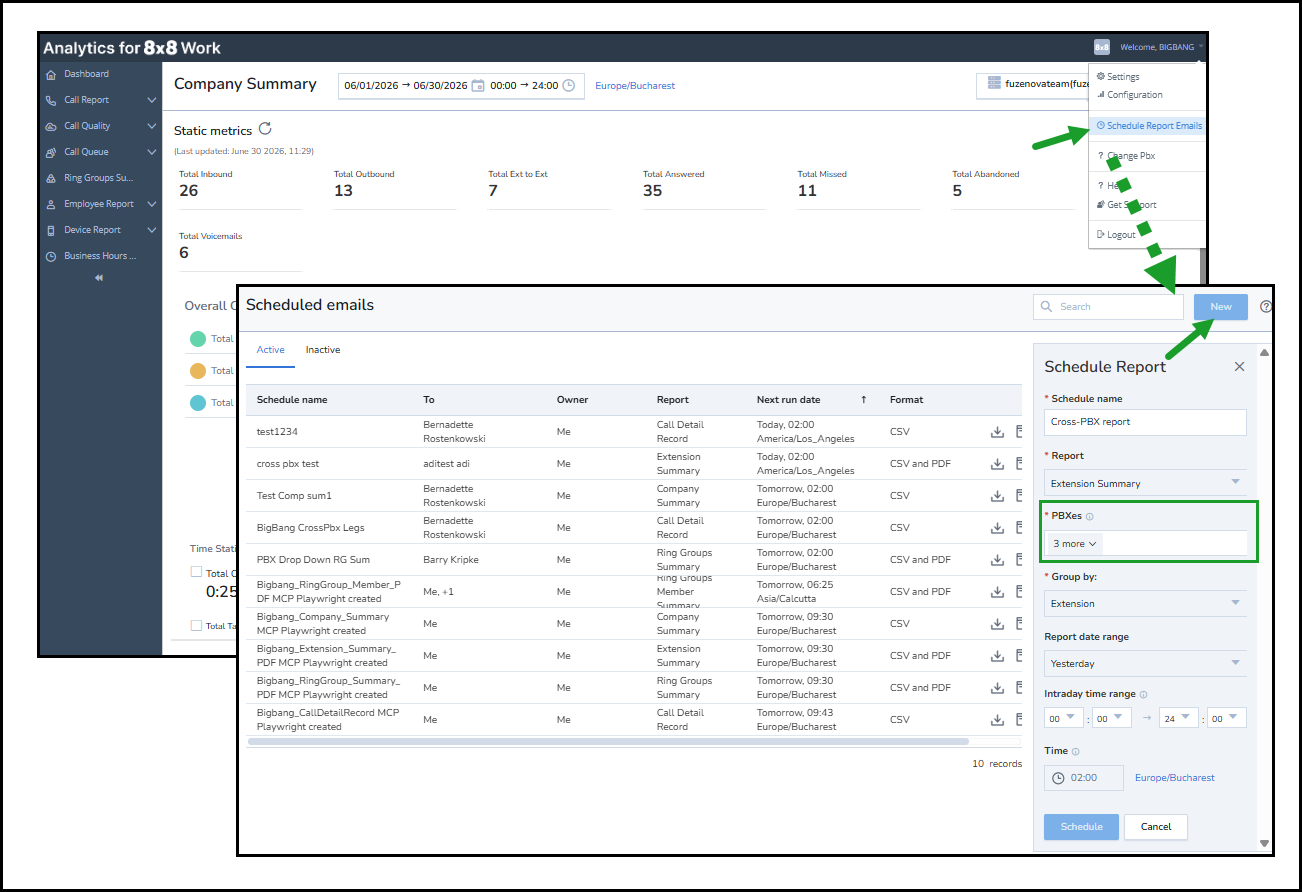
Scheduled reports now support cross-PBX reporting. When you create or edit a scheduled report, you can select one, several, or all of your PBXs.
- Multi-PBX filter. Select one, some, or all of your PBXs when creating or editing a scheduled report.
- One combined CSV file. All data appears in a single file with a PBX ID column that identifies which PBX each row belongs to. This column is mandatory, always visible, and applies to reports created before this release.
- Aggregated PDF charts. Top departments, extensions, sites, and user groups now appear as aggregated totals across the selected PBXs.
- Role-Based Access Control (RBAC) support. Cross-PBX scheduled reports respect your RBAC permissions. If you do not have access to a particular PBX, it does not appear in your report.
Note: The RBAC feature is currently in Beta. To request activation, contact your 8x8 Account Manager.
What didn't change
This update does not affect your existing SKU or data retention policies. Your current scheduled reports continue to work as expected, and you can edit them at any time to include additional PBXs.
Note: This release is the first phase of cross-PBX analytics. 8x8 plans to expand this support to individual reports in future updates, based on customer feedback.
Limitations
Cross-PBX scheduled reports are available to users with the Analytics Essential role.
Scheduled reports for ring groups require the Analytics Supervisor role, which is part of the X4 license.
To learn more, see Scheduled report emails.
Ability to grant users access to a data subset based on their roles and permissions (Beta)
Note: This feature is currently In Beta. To request activation, contact your 8x8 Account Manager.
Analytics for 8x8 Work now enables customers to limit user access to reporting data based on roles (Analytics Supervisors and Essentials) and assignments (User Groups, Call Queues and Ring Groups) that an admin assigns through the Role-based Access Control (RBAC) in the 8x8 Admin Console. Users can only view specific analytics and recording data subsets. For example, supervisors can see recordings pertaining only to the groups they oversee and their associated members.
Moreover, new User Group-specific reporting is also available, organizing data according to User Groups created by admins in the 8x8 Admin Console. Previously, users had access to all PBX, Call Queue, and Ring Group data, while specific reports (Essentials or Supervisors) were restricted exclusively to users with particular licences.
Role-Based Access Control management
Role-Based Access Control (RBAC) in 8x8 Work manages user permissions for analytics and reporting data according to their roles (Analytics Supervisors and Essentials) and assignments (associated with User Groups, Call Queues, and Ring Groups), ensuring they can only access necessary information.
For example, one role might allow full access to all the analytics and recording data from Analytics for 8x8 Work, while another is restricted to a specific subset of data. RBAC now offers system-defined roles and the ability to create custom roles with specific scopes to cater to different needs.
Examples of use cases:
- Business units operating independently within a global corporation - Supervisors from a unit that functions separately can access only data from their unit without access to information from other units.
- Car dealership - The owners desire visibility across all brands; however, dealership A must not have access to analytics or recordings from dealership B.
- Leadership privacy - To protect the confidentiality of sensitive data, allow access to call recordings without executive extensions for a specific user group.
User Groups feature in Analytics for 8x8 Work
Admins can create User Groups to further restrict data access. User Groups enable customer admins to restrict the scope of access within specific role assignments, offering tailored data access, such as recording data. For example, supervisors can view recordings only for their responsible groups and members.
Note: Customer admins can assign users to a single User Group through any user administration flow (8x8 Admin Console).
When configuring an RBAC assignment for a specific supervisor role (with access permissions granted to a restricted set of data), admins must set up two components:
- Role: Refers to permissions for functionalities, such as using Analytics reports (including Analysis Essentials and Analysis Supervisors).
- Scope: Defines how these permissions apply to data, such as company-wide or specific PBXs, or user groups (User Group, Ring Group, and Call Queue).
General Rules for Role-Based Access Control for Analytics for 8x8 Work
Access control based on User Groups allows customers to define the scope of permissions, such as company-wide or specific PBXs, or user groups.
-
Supervisors can be assigned permission to access data with a combination of multiple scope types (similar to Contact Center Analytics permissions):
- User Groups - allowing access to data relating to calls from or to any member associated with those groups:
- Call Queues
- Ring Groups
-
Upon gaining access to User Groups, Queues, or Ring Groups, the user obtains access to:
- ALL historical activity data of those groups and queues, regardless of who the members are.
- ALL ongoing activity data of those groups and queues, regardless of who the members are.
Note: Currently, customers who enable granular RBAC can only access the reports listed below. Due to ongoing modernization efforts, other reports are currently hidden.
- Company Summary
- Extension Summary
- Call Detail Records (CRDs)
- Ring Group Summary
- Call Quality trend
Access control to the Analytics for 8x8 Work based on roles and permissions (Beta)
Note: This feature is currently in Beta. To access this feature, contact your .account representative.
As an 8x8 Work administrator, you can manage user access to reporting data based on predefined permissions and access groups.
You can grant full access or limit users to a specific access group, call queue, and/or ring group scope.
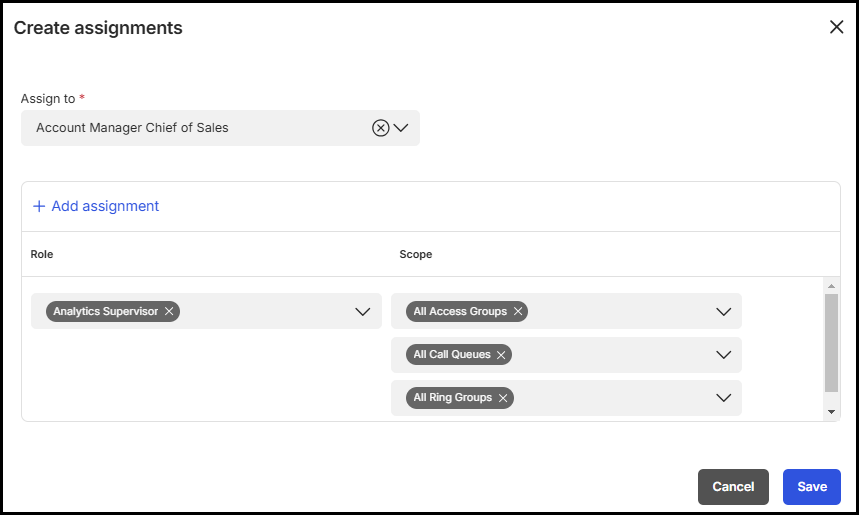
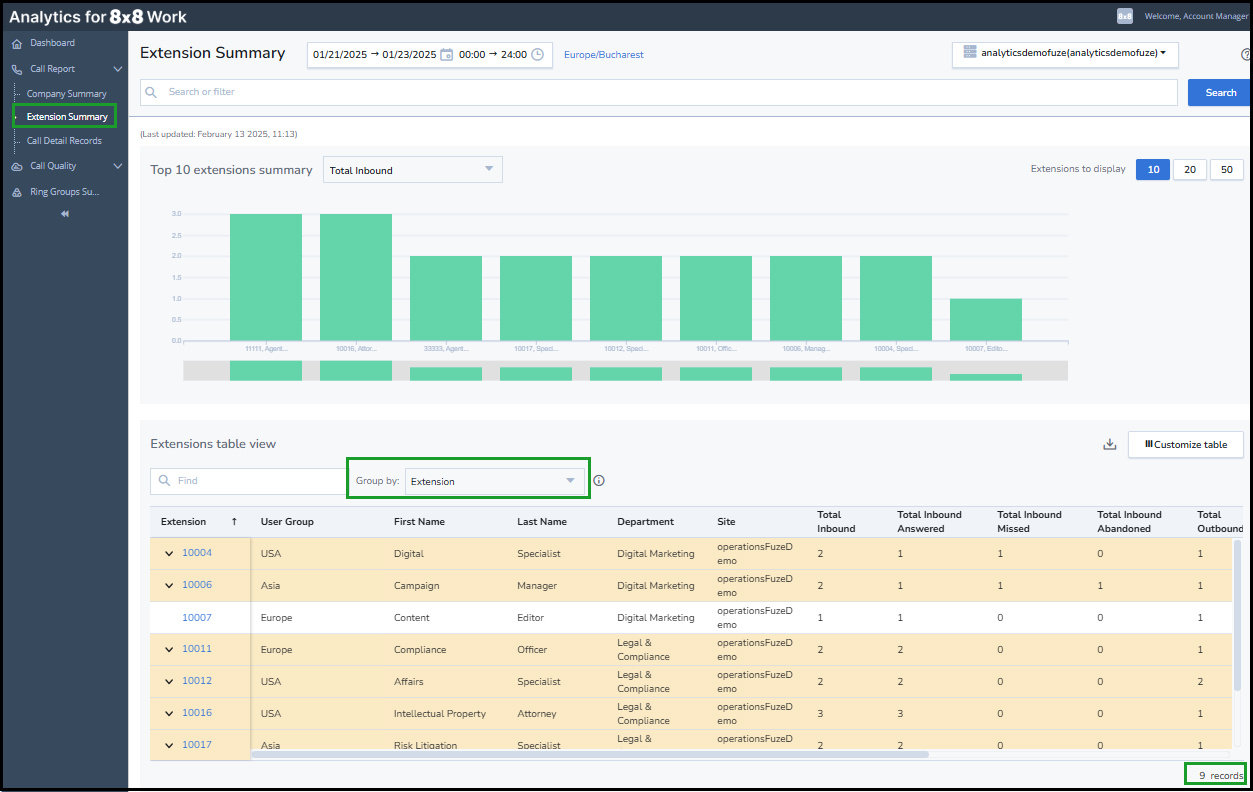
Users can see various results depending on their full or limited access permissions. Restricted users can access less data than those with full access.
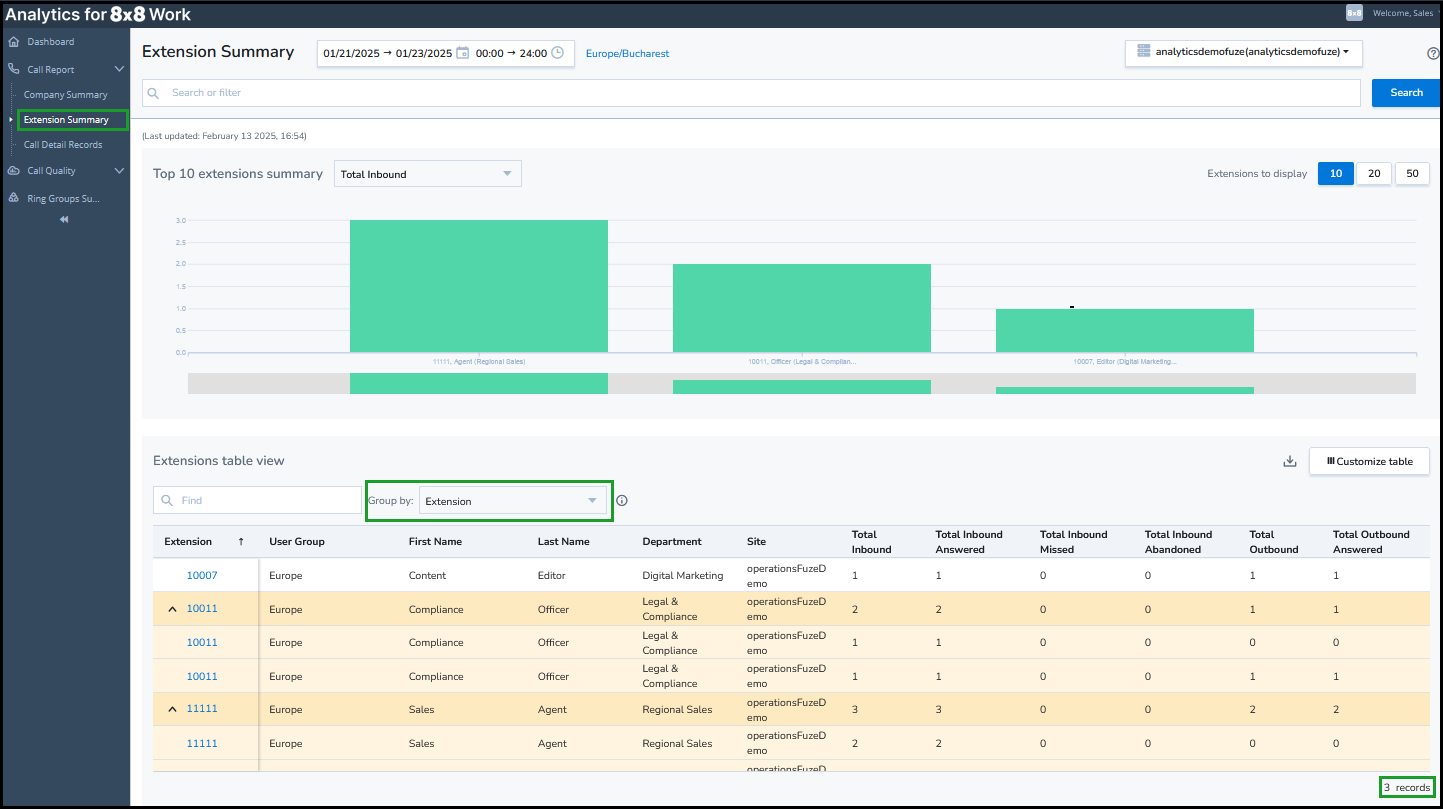
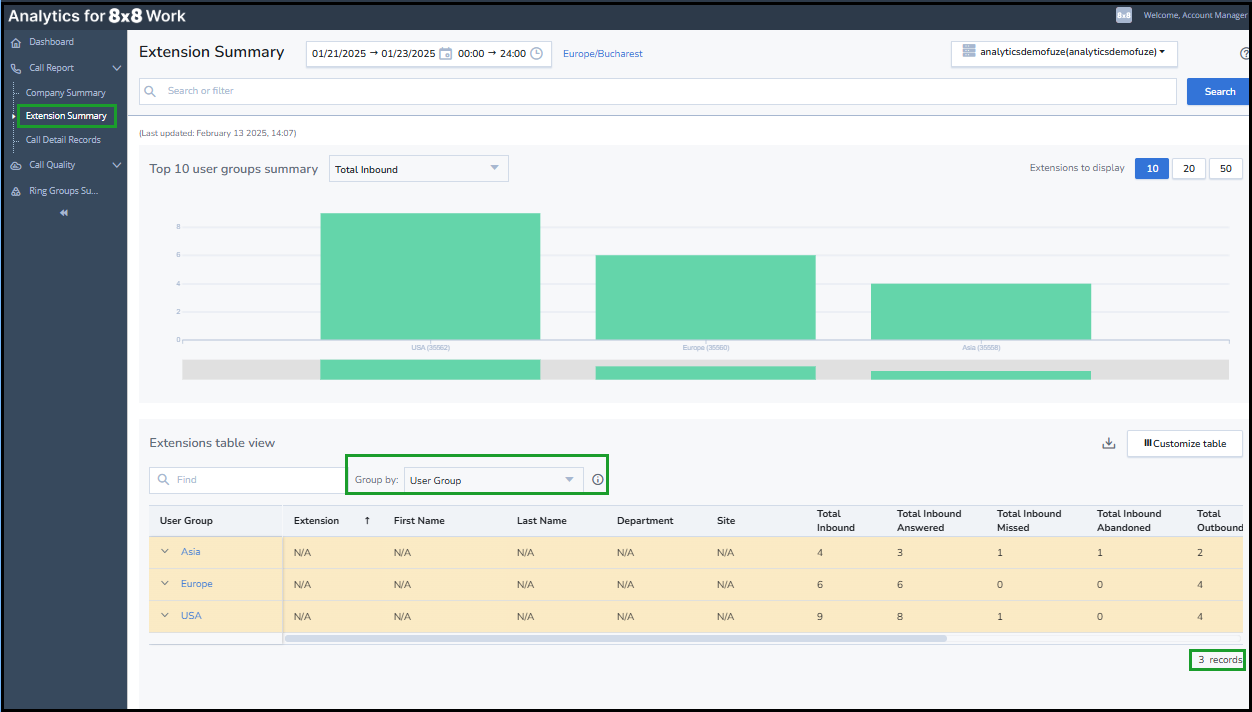
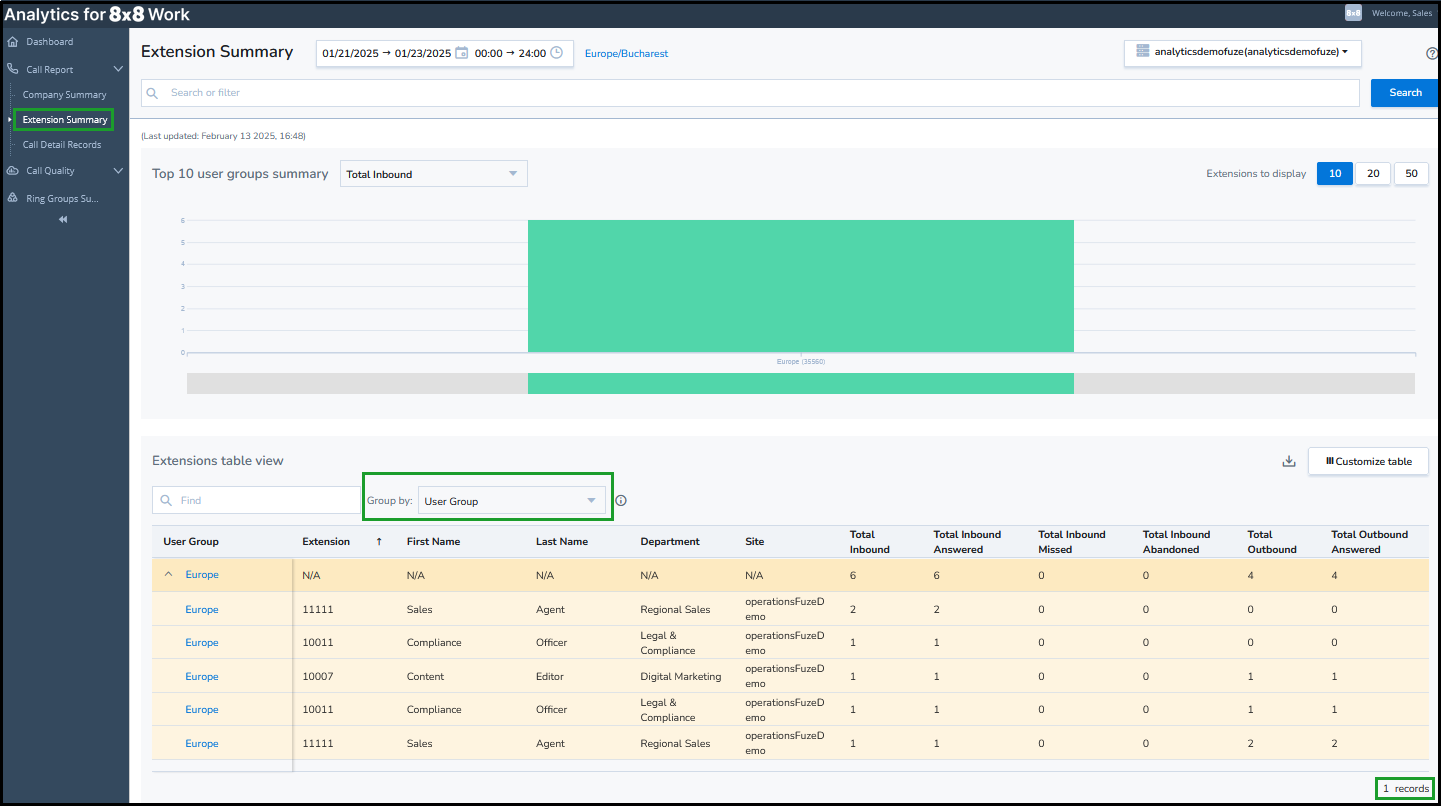
The company Summary report data view
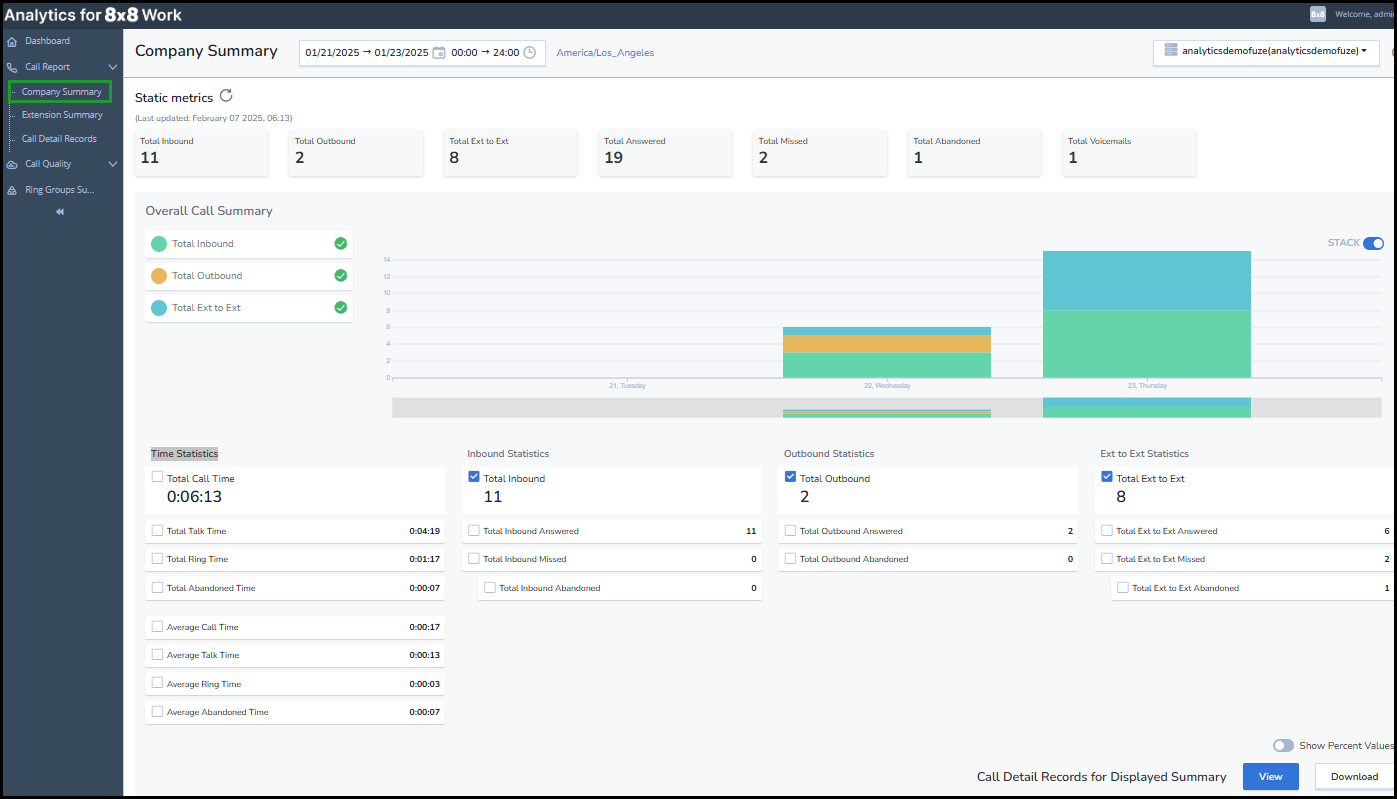
The Company Summary dashboard provides a high-level overview of usage of your business phone system.
This report does not filter the displayed data, presenting all metrics to users regardless of their access permissions, whether full or limited
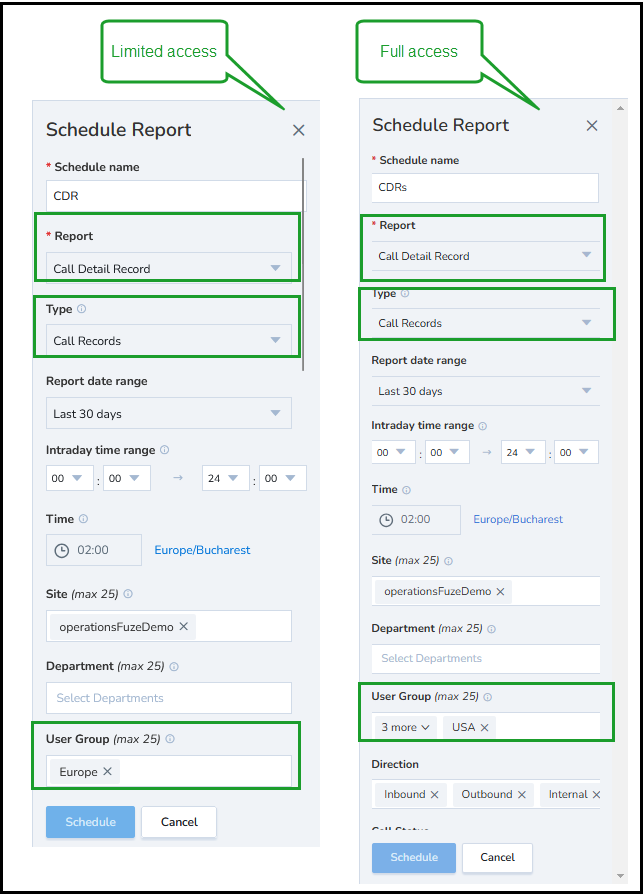
 The Call Detail Records report data view
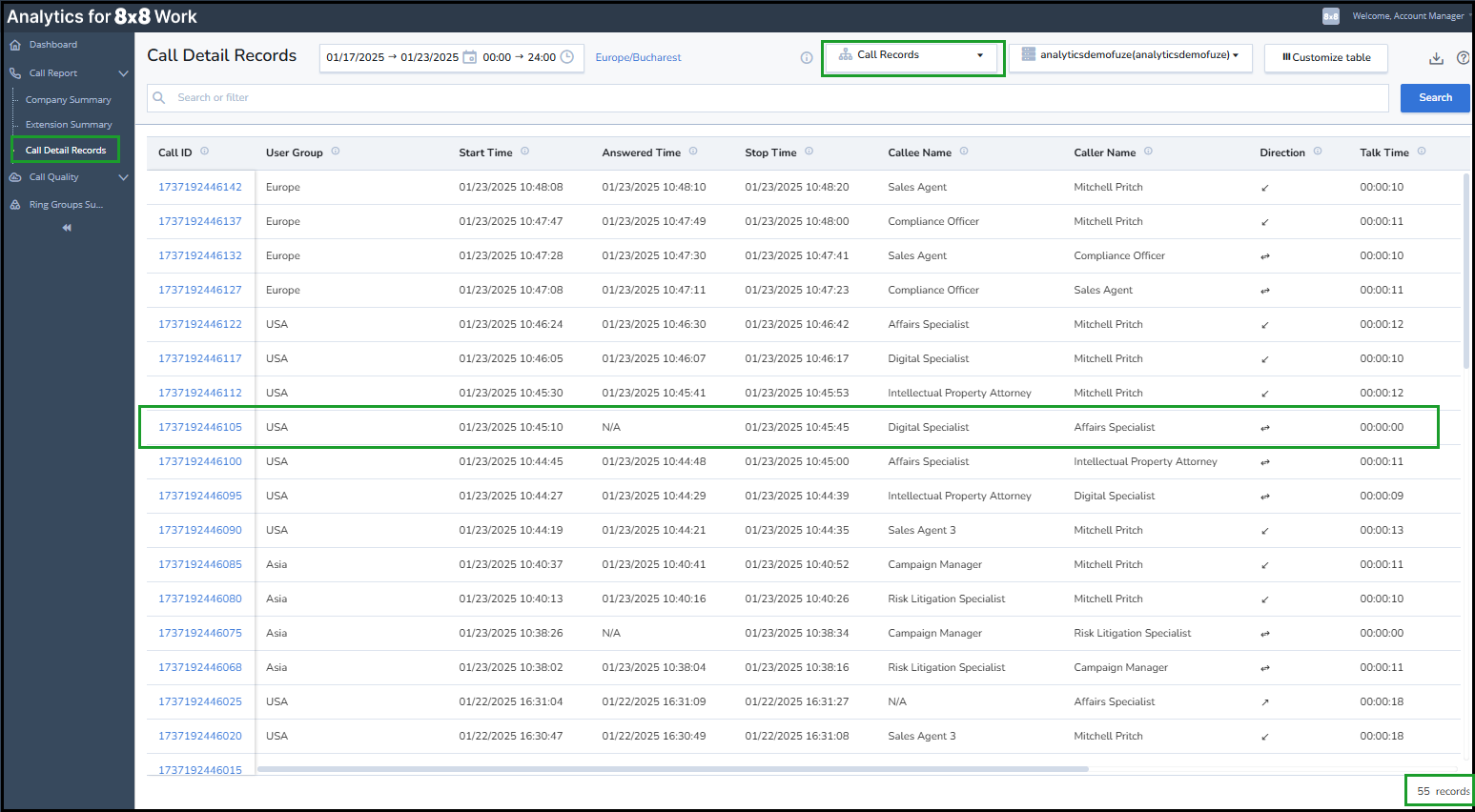
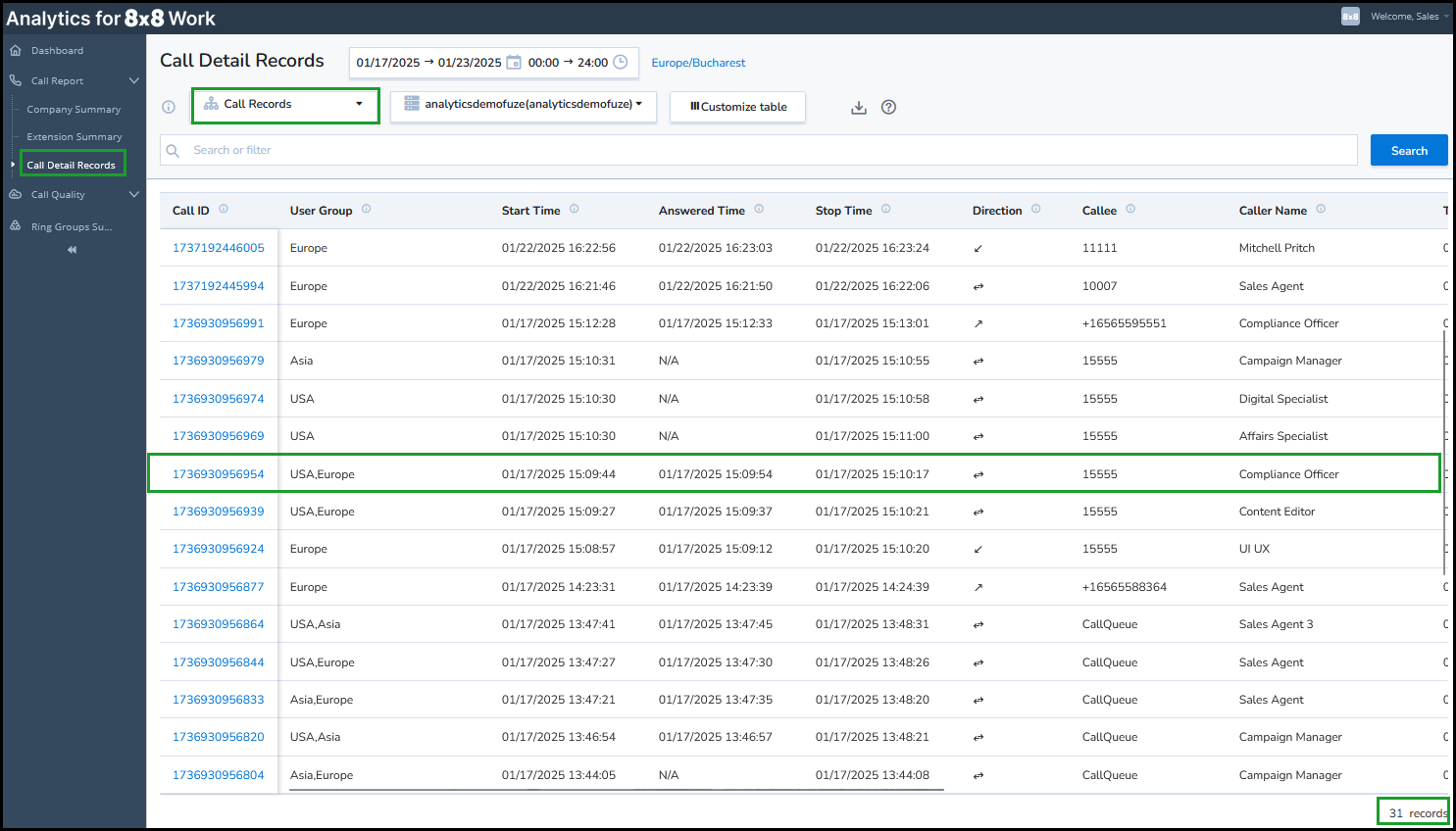
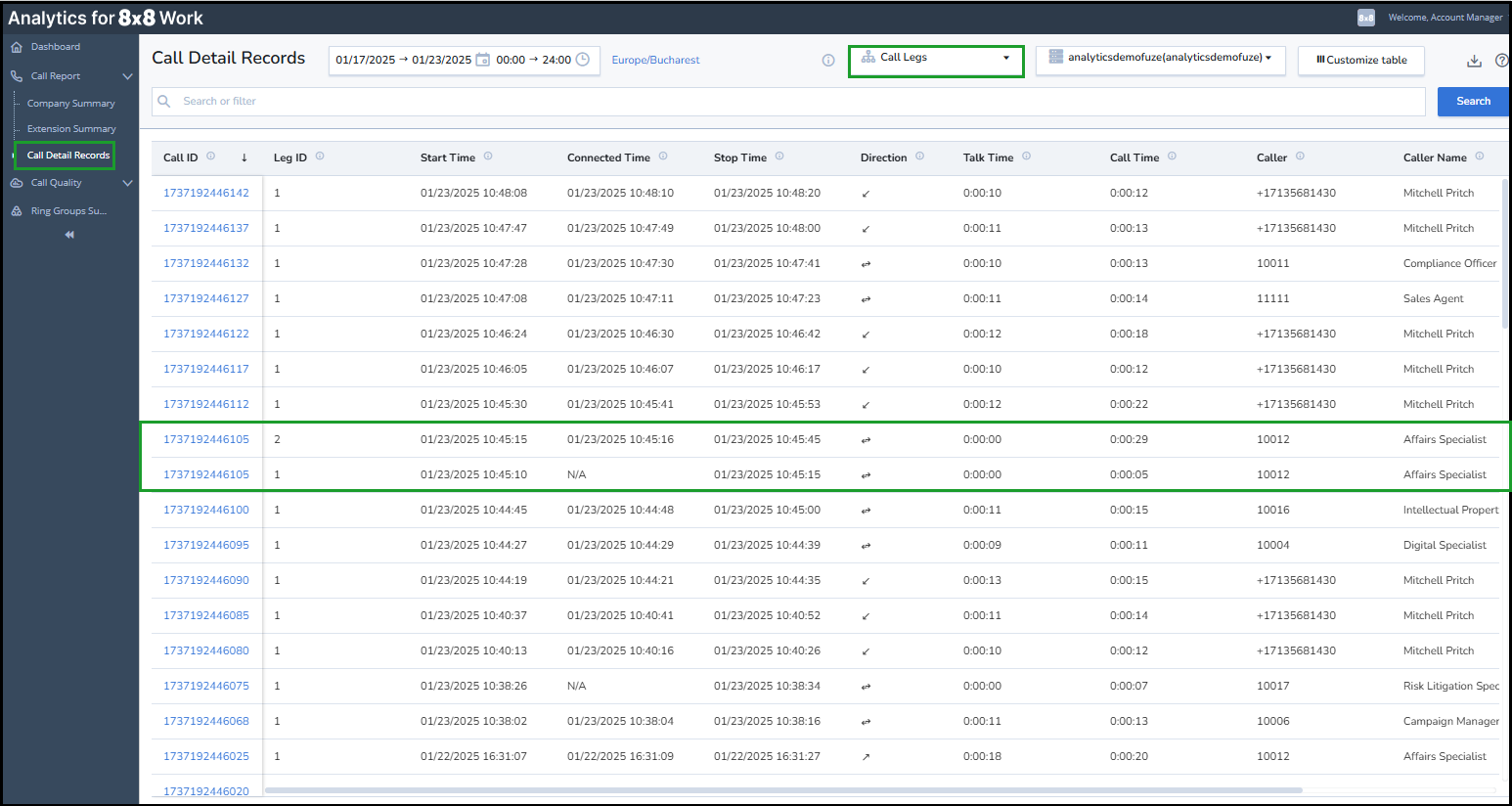
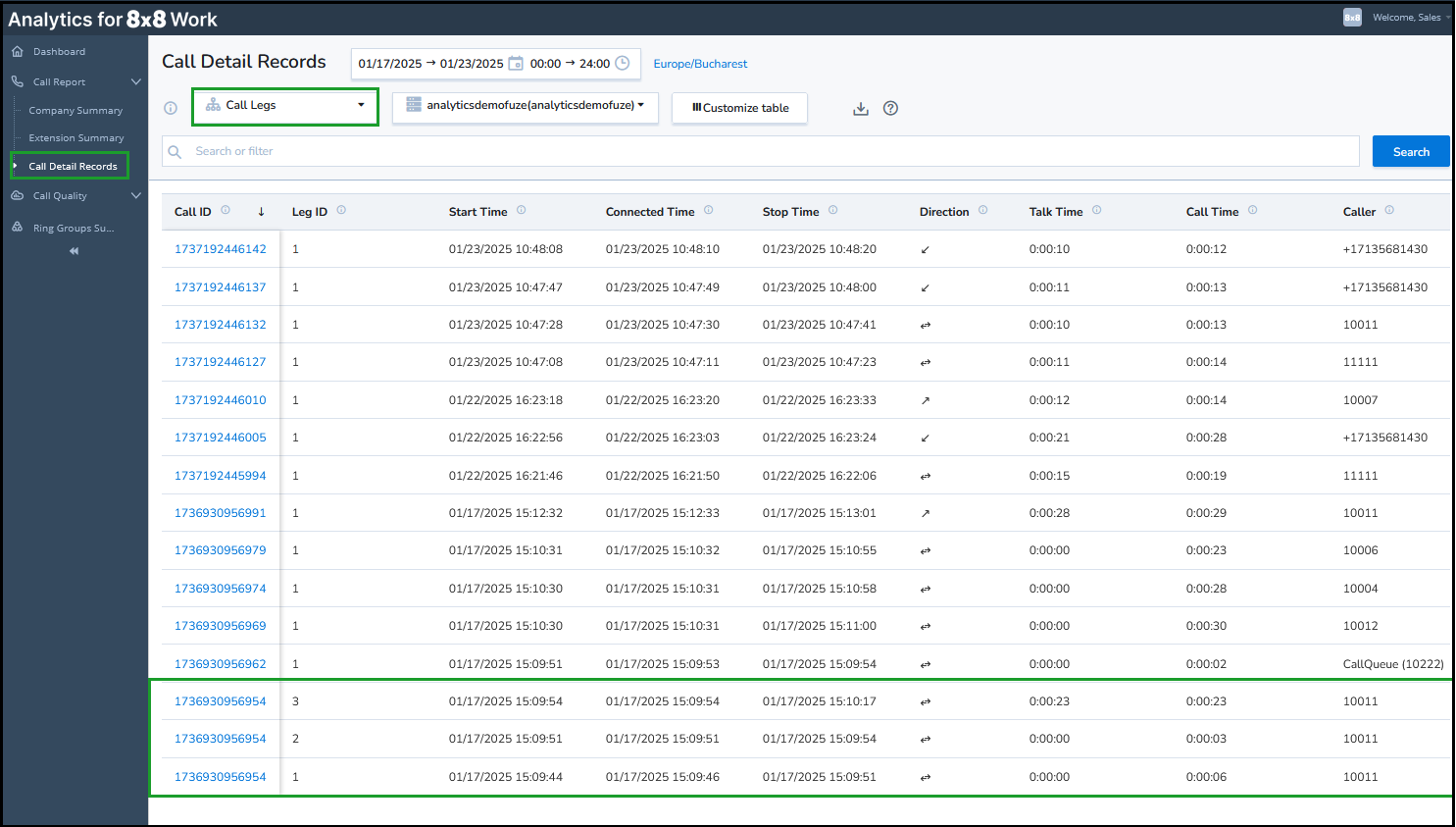
The Call Detail Records (CDRs) report provides information about all inbound and outbound calls processed within the specified time frame selected by the user.
- The CDRs report presents data organized by Call Records and Call Legs data view.
- Users may observe different results based on their access permissions. They can view only the records related to User Groups, Call Queues, and Ring Groups to which they have access.
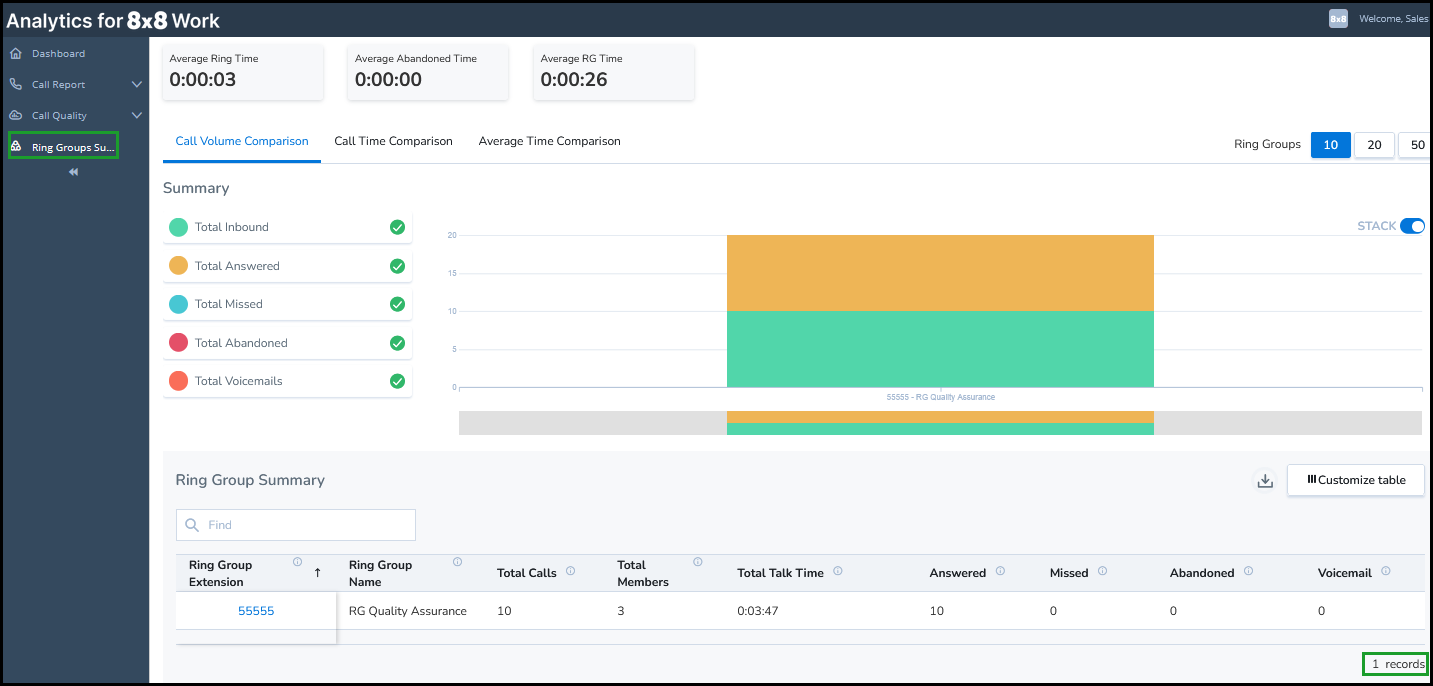
The Ring Group Summary report data view
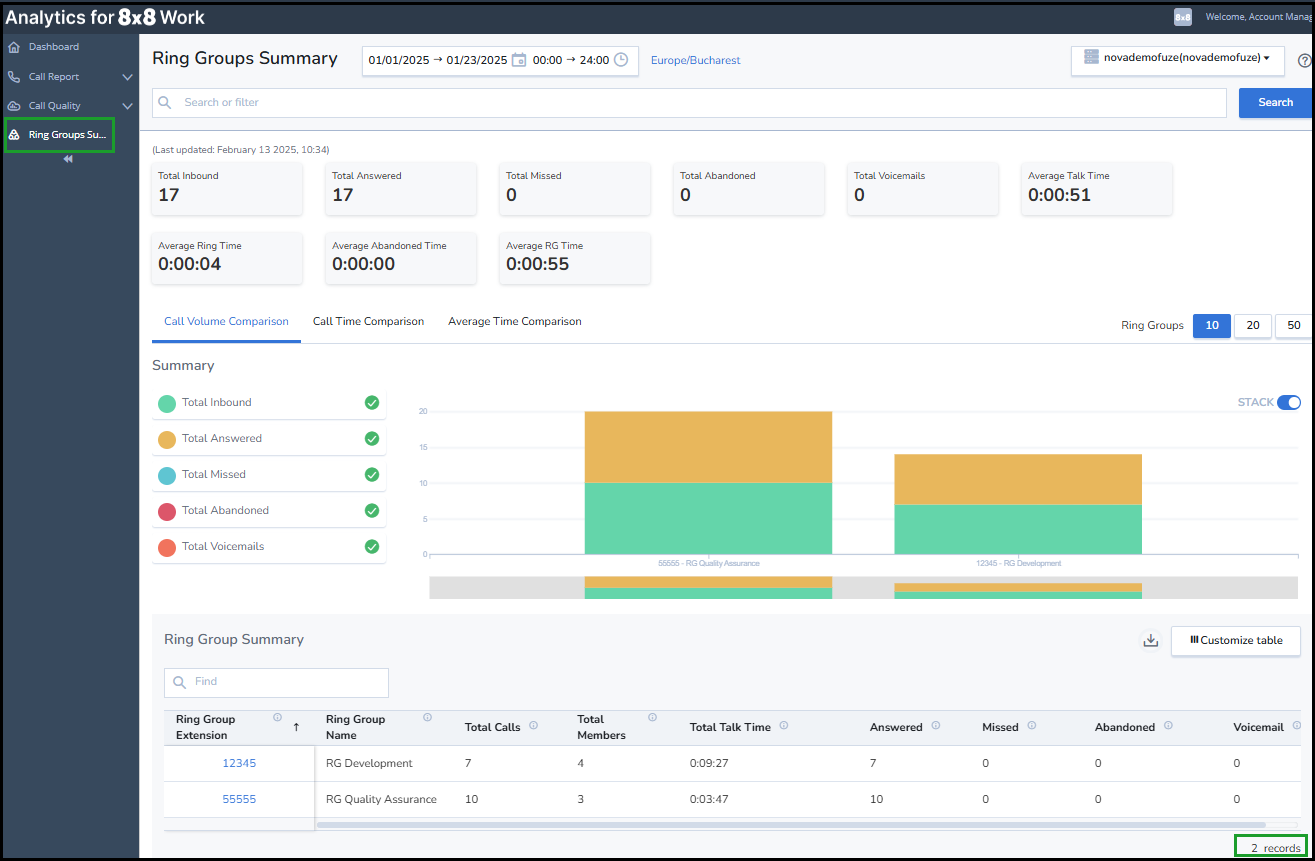
The Ring Group summary report provides information on tracking call traffic and average call handling times for each ring group.
Users may observe different results based on their full or limited access permissions. Restricted users can access fewer data than those with full access, while users with full access can view all records associated with the ring groups that they have access to
Configuration of scheduled report emails
Users can access a summary of their organization call activity, including regular agent performance and effectiveness updates. Scheduled reports can be programmed to recur at specified intervals, with daily, weekly, or monthly email delivery options.
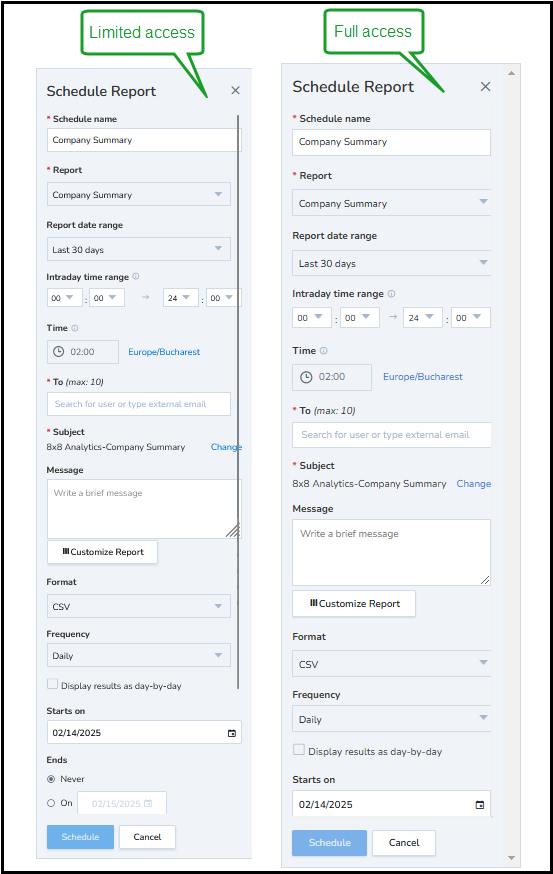
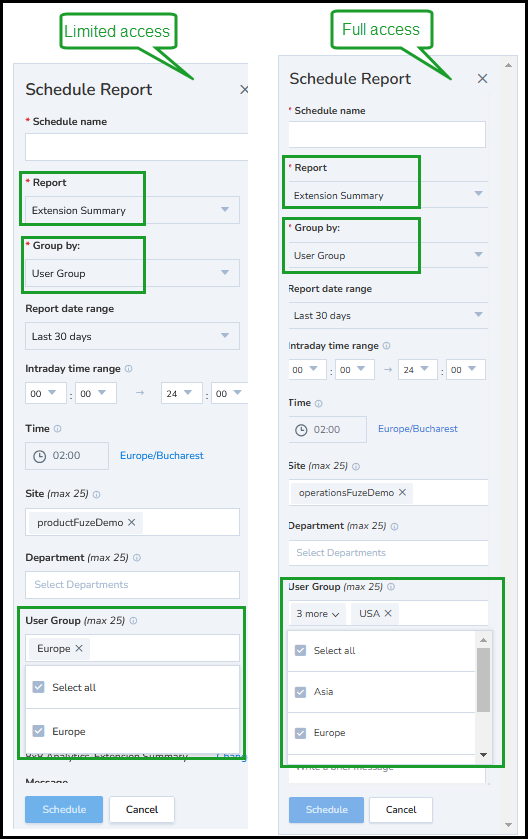
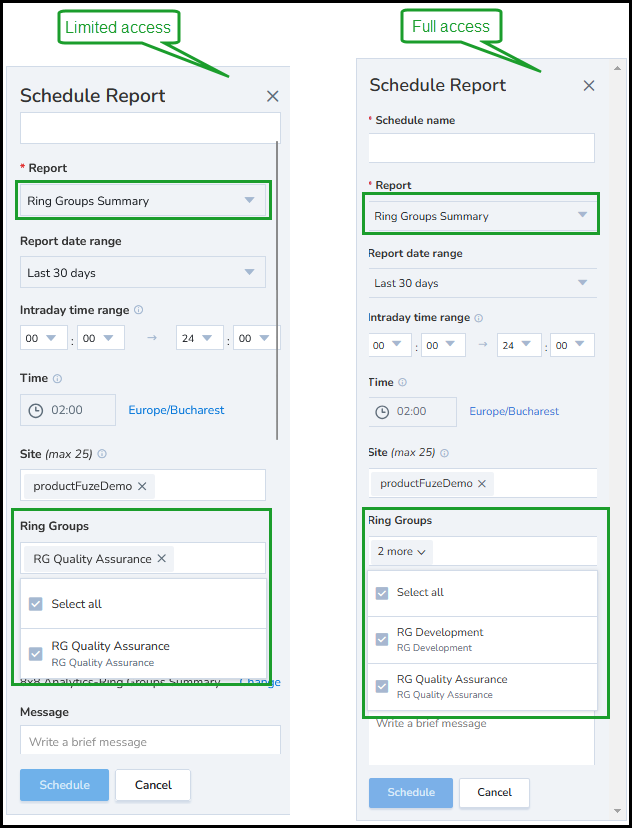
To learn how to control user access to Analytics for 8x8 Work reports, see Access control to the Analytics for 8x8 Work based on roles and permissions.
What's new in the Analytics for 8x8 Work May 2026 release?
In the May 2026 release of Analytics for 8x8 Work, we have introduced the following enhancements:
Per-user counts and totals in the Users table
The Call Queues dashboard Users table now includes an explanation of how calls are counted differently in per-user rows and the Totals row, along with a worked example and quick reference table.
Benefits
- Per-user call counting guidance: The Call Queues dashboard Users table now includes an explanation of how calls are counted in per-user rows and the Totals row, along with a worked example and quick reference table.
- Individual agent responsiveness metrics: Per-user Missed Calls and Rejected Calls data helps supervisors assess how individual agents respond when calls are offered to them.
The new content includes:
- An explanation of how Offered Calls, Answered Calls, Rejected Calls, and Missed Calls are counted at the per-user level.
- A worked example showing how a single call distributed across two users produces different values in per-user rows, the Totals row, and queue-level metrics.
- Guidance on how to use per-user metrics to evaluate individual agent responsiveness and identify coaching opportunities.
- A quick reference table summarizing what each view counts and how to interpret the results.
For details on how per-user counts and totals work, see Differences between per-user counts and totals in the Users table.
Call Queues report metrics updates
The Call Queues report includes the following updates in this release:
- A new outcome metric, Diverted, has been introduced along with Diverted %.
-
Live Waiting metrics have been updated to record duration exclusively for calls actively in the Waiting state. Previously, waiting time reached a fixed accrued value and then added waiting time from other queued calls, only resetting once the call concluded. Now, wait time stops accumulating the moment a call leaves the Waiting state, providing supervisors with a more precise and realistic view of actual queue latency.
Benefits
- Updated Call Queues metrics: The Call Queues report includes two new outcome metrics and revised Waiting metric behavior, with updated definitions for Completed, Missed, and Abandoned.
The following metrics have been removed from the historical Call Queues report:
- Abandoned In Handling
- Abandoned In Handling %
- Rejected
- Rejected %
The definitions of the following metrics have been updated to reflect these changes:
- Completed
- Missed
- Abandoned
The live call time accumulation behavior section has also been updated to reflect the revised Waiting metric behavior.
To learn more, see Glossary: Queues metrics; Real-Time widgets, and Glossary: Real-time widgets metrics.
What's new in the Analytics for 8x8 Work March 2026 release?
In this release of Analytics for 8x8 Work we have introduced
Enhanced Call Queues dashboard for general availability
The March release of Analytics for 8x8 Work introduces the Call Queues dashboard, which is now generally available. This dashboard offers a single view for monitoring queue performance and agent activity.
The Call Queues dashboard is an updated version of the Call Queues (Beta) report in combining queue monitoring into one unified view. It replaces four old reports, offering real-time and historical data on queue performance and agent activity. This unified view helps supervisors monitor service levels and analyze queue operations more effectively.
What changed
This updated Call Queues dashboard replaces the following legacy reports:
- Queue Board
- Queue Listing
- Queue Detail
- Queue Call Data
The new dashboard consolidates queue metrics, agent performance data, and call records into a single reporting workspace.
Capabilities
-
Unified queue monitoring: View real-time and historical queue metrics in one dashboard
-
Real-time and historical queue metrics: Monitor live queue activity and agent availability
-
Multi-queue comparison: Compare multiple queues simultaneously
-
Agent and call-level insights: Analyze agent performance and call records
Differences from the Call Queues legacy reports
The new report consolidates functionality from several legacy reports into a single interface.
The following table shows where each legacy report feature is now located.
| Legacy report | Where to find it in the new report | Description |
|---|---|---|
| Queue Board | Widget tiles at the top of the report | These widgets tiles provide a quick overview of key queue metrics. |
| Queue Listing | The Queues table with real-time and historical metrics | The updated Queues report provides even more historical and live metrics to monitor queue performance. |
| Queue Detail | Distributed across the Widgets, Queues table, and Users table |
Use the Queue filter to focus the report on a specific queue. Use the calendar (date and time) selector to switch between live (real-time) and historical views:
|
| Queue Call Data | The queue drill-down view is accessible from the Queues table | The data from Queue Call Data legacy report is now integrated within each queue in the Queues table. Selecting a queue allows you to drill down and download call data for that queue. This view allows you to download all associated call data for the selected queue. |
Access the Call Queues dashboard
The new dashboard is accessible from the Call Queue menu in 8x8 Analytics for 8x8 Work.
To access the new dashboard:
- Log into 8x8 Analytics for 8x8 Work.
- Go to Call Queue
 > Call Queues (New).
 -
Select the date range and time zone. To learn more, see Customize the report settings.
-
Apply filters for PBX, sites, queues, or users. To learn more, see Customize the dashboard view.
The dashboard then displays real-time and historical queue metrics based on the selected filters.
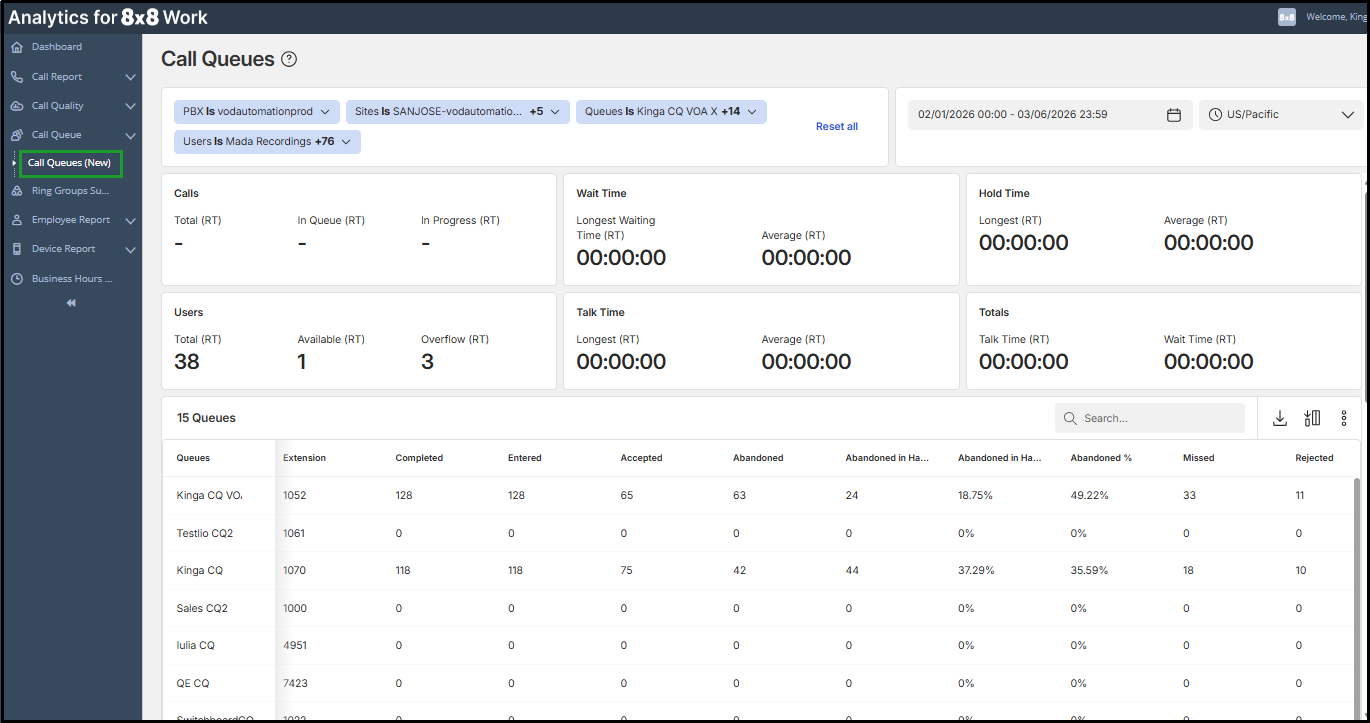
For more information, refer to the dedicated section for Get Call Queues metrics .
What's new in the Analytics for 8x8 Work February 2026 release?
In this release of Analytics for 8x8 Work we have introduced the following reports:
New Unreturned Calls report
The updated Unreturned Calls report replaces the legacy version and provides a modern, streamlined experience with improved filtering and clearer metric labels and tooltips. This enhancement improves filtering, clarity, and usability, enabling teams to quickly identify missed calls that were not returned and follow up with customers more efficiently.
It displays calls that were missed and not returned by any extension within the PBX, including calls that were redirected but never returned by the final recipient. Users can quickly recognize missed calls and promptly return them to customers.
Who should use this report?
This report is designed for administrators, supervisors, and operations teams responsible for monitoring missed calls and ensuring timely customer follow-up.
What changed from the legacy report?
The new Unreturned Callsreport includes:
- Improved, more visible filtering by PBX, Caller and Callee
- Clearer metric titles
- Automatic data refresh every five seconds
- A modernized interface aligned with 8x8 design standards
Features
- Modern experience: Updated navigation and visuals aligned with 8x8 design standards.
- Improved filtering: Filter unreturned calls by PBX, caller, or callee to narrow results quickly.
- Enhanced search: Quickly locate specific unreturned calls using searchable columns. All the columns are searchable.
- Sortable columns: Sort data alphabetically or numerically in any column.
- Real-time updates: Data refreshes automatically every five seconds.
- Export options: Download reports in CSV or Excel format.
- Persistent settings: Saved filters and column selections remain when navigating away.
- Clearer metrics: Updated labels reduce confusion and improve understanding.
Benefits
- Improve customer response time: Quickly identify missed calls that were not returned and follow up with customers.
- Reduce missed opportunities: Gain clear visibility into unreturned calls across your PBXs.
- Simplify monitoring: Use a consistent, modern analytics experience aligned with other 8x8 reports.
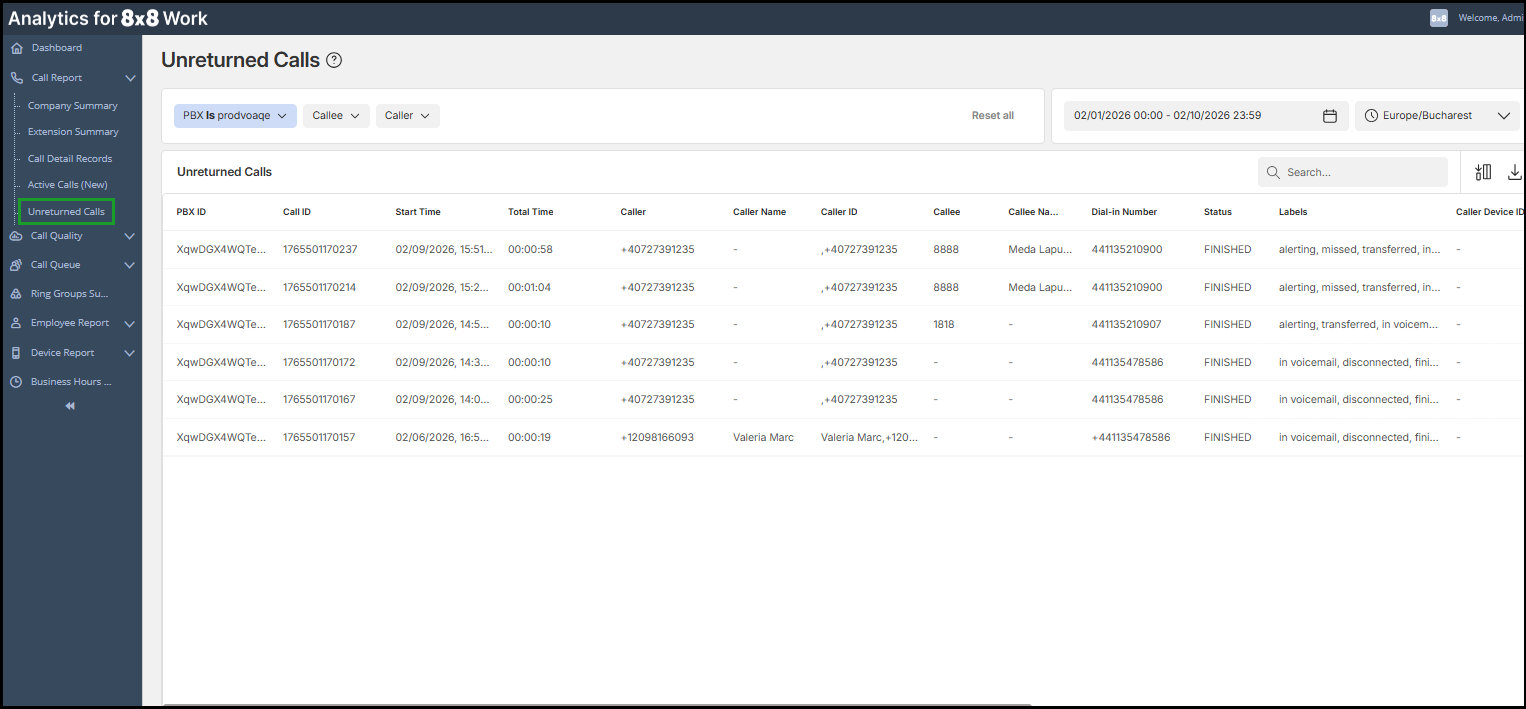
Access the Unreturned Calls report
The Unreturned Calls report is available in 8x8 Analytics for 8x8 Work.
To access the new report:
- Log in to Analytics for 8x8 Work.
- From the left navigation menu, go to Call Report
 > Unreturned Calls.
 -
Use the date range and time selectors to choose your desired date and time range. To learn more, see Customize the report settings.
Note: The report displays data for the past 14 rolling days, even if a longer timeframe is selected.
- Apply filters for PBX, Callee and Caller as needed. To learn more, see Customize the report.
Notes:
- By default, the report displays unreturned calls from the past two weeks.
-Once a call is returned, it is automatically removed from the table.
- To download the report in CSV or Excel format, use Export this file  in the upper-right corner of the table.
Customize the report
You can tailor the Unreturned Calls report to focus on the metrics most relevant to your workflow.
Customization options include:
- Filters: PBX, Caller, and Callee
- Column selection: Show, hide, or reorder columns
- Search: Quickly find specific unreturned calls using searchable columns. All the columns are searchable.
- Sortable columns: Sort any column alphabetically or numerically
- Date and time range: Select preset or custom ranges
- Time zone: Adjust the display to your preferred time zone
Notes:
- Persistent settings: Saved filters and column selections remain between sessions
- Export: Save filtered views as CSV or Excel
To learn more, see Customize the Unreturned Calls report.
Glossary and metric definitions
Need help understanding the metrics in the Unreturned Calls report? For detailed definitions and explanations, see Glossary: Unreturned Calls.
To learn more, see Run Unreturned Calls Report.
New Device Status Dashboard
The Device Status dashboard is a modern replacement for the legacy Device Status Detail report, offering an improved way to monitor the status of devices and endpoints.
It provides real-time visibility into endpoint availability across sites, allowing teams to quickly identify which devices are in service or out of service and take action before issues impact users. With consistent metrics across 8x8 products, the dashboard feels familiar and easy to use, helping administrators detect failures faster and troubleshoot with confidence.
Benefits
- Modern user experience: Navigation and visuals align with 8x8 design standards, making the dashboard easy to use.
- Faster troubleshooting: View overall and individual device status in one place to quickly identify problem areas at a glance across multiple locations.
- Focused filtering: Filter devices and endpoints by PBX to narrow results and speed up investigation.
- Clear ownership: Easily associate devices with users for faster issue resolution.
Features
- Monitor the real-time status of all endpoint devices in your 8x8 cloud phone system.
- Identify network service issues, such as outages during a large storm.
- View the geographic location of devices to pinpoint location-based problems.
- Proactively detect and fix service disruptions before they impact users or call center performance.
- Customize views using filters for PBX, Service Type, Device Type, and Device Site.
- Export filtered reports as CSV or Excel for analysis and record keeping.
Access the Device Status dashboard
The Device Status dashboard is available in 8x8 Analytics for 8x8 Work.
To access the new dashboard:
- Log in to Analytics for 8x8 Work.
- From the left navigation menu, select Device Report
 > Device Status .
 - Use filters such as PBX, Service Type, Device Type and Device Site to refine the data. To learn more, see Customize the Device Status dashboard.
Notes:
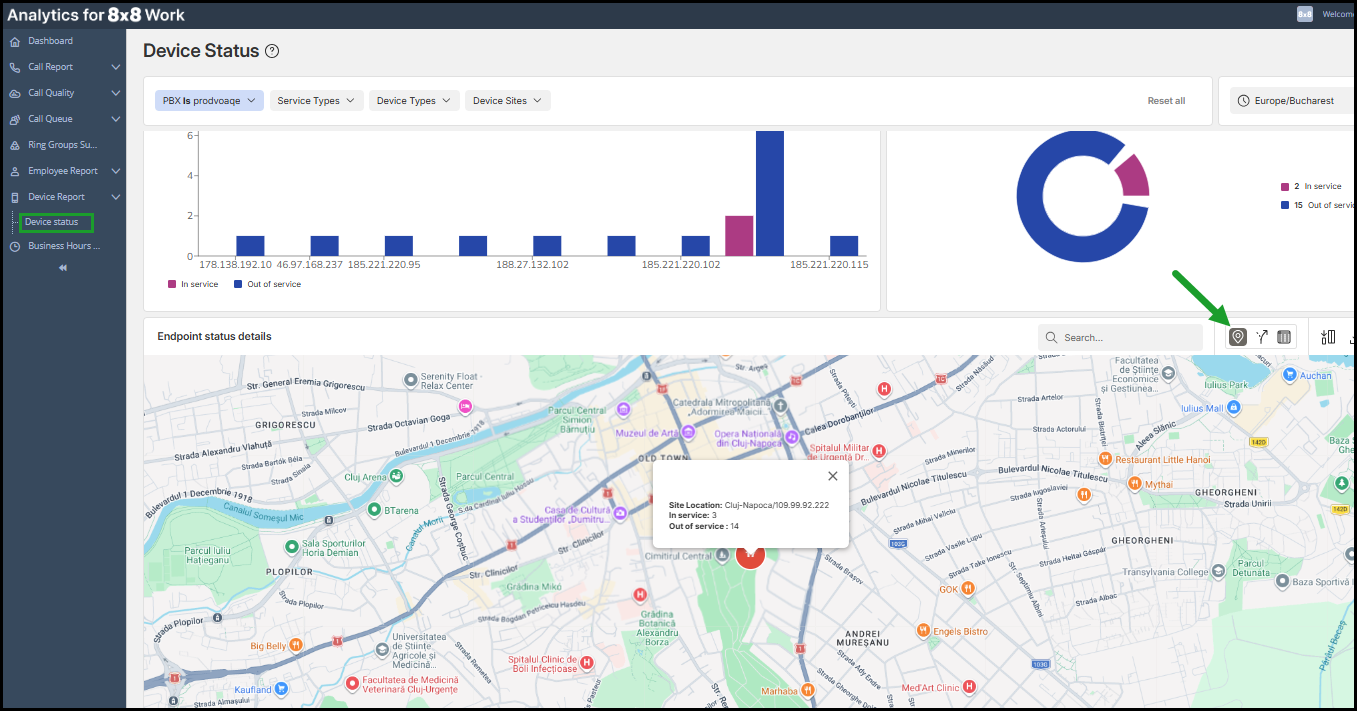
- When viewing the site location map or routing map, click the  map control in the upper-right corner of the map to open the endpoints details view.
- Click Export this file  in the upper-right corner of the Endpoints status details table to download reports as CSV or Excel.
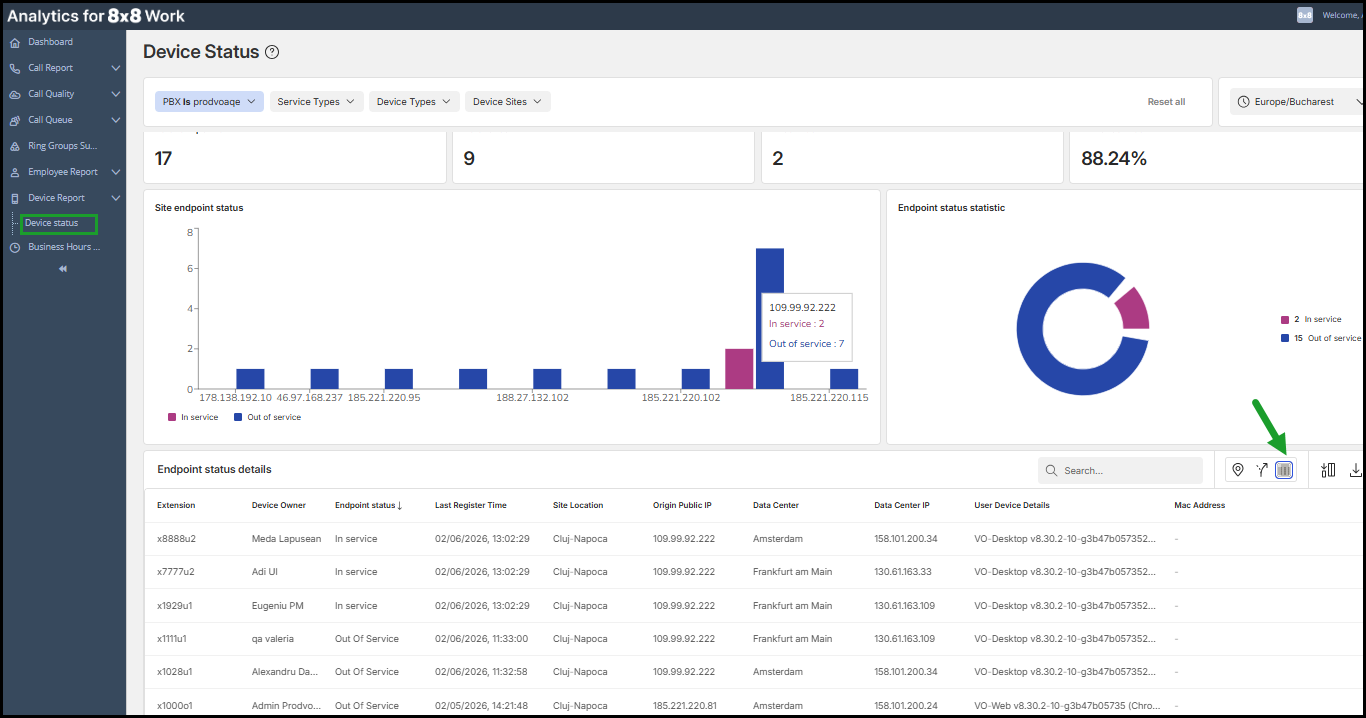
Maps
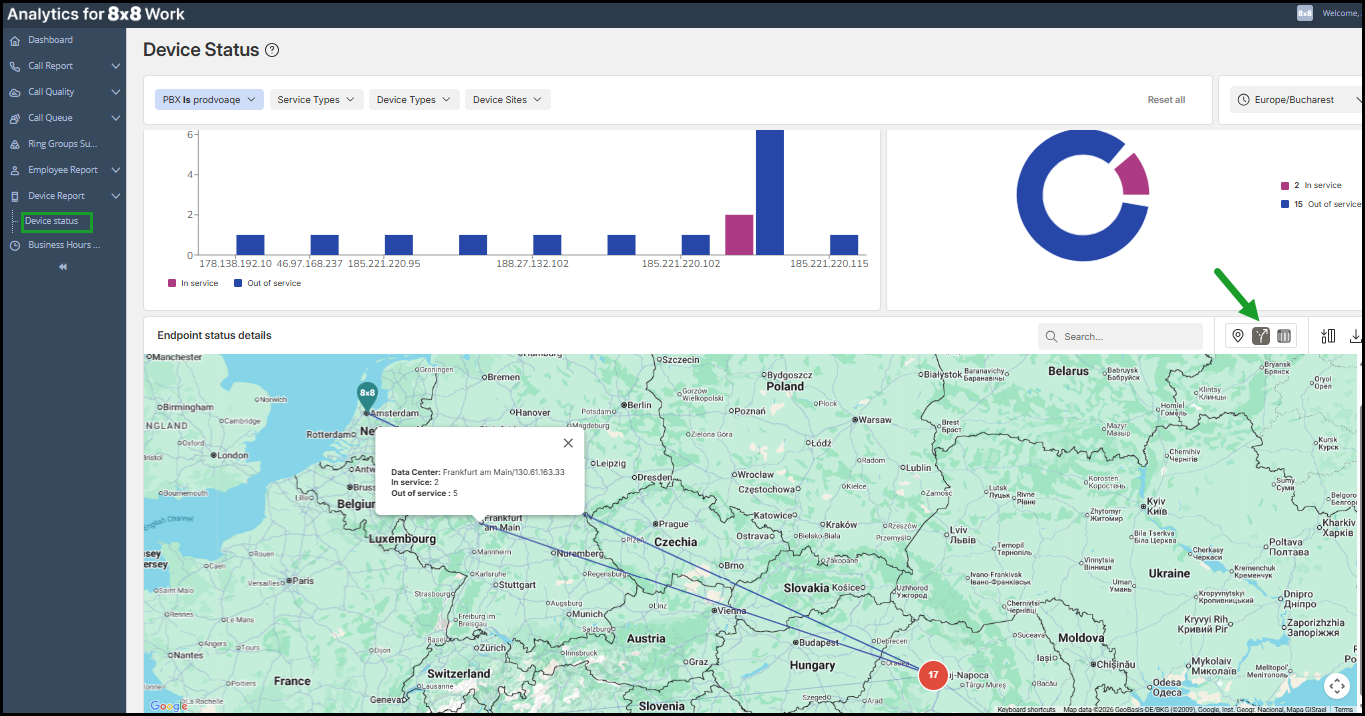
The Device Status dashboard includes interactive maps that help visualize endpoint distribution and service status by location. You can switch between the Site Location Map and the Routing Map to identify location-based service issues.
Site Location Map
The Site Location Map shows the geographic distribution of endpoints by site. Selecting a location displays how many endpoints are in service or out of service, helping you quickly understand site-level operational status.
Routing Map
The Routing Map displays real-time endpoint distribution and routing paths across regions. This view helps identify regional or routing-related service issues by showing where endpoints connect and how traffic flows.
Access map views
- Open the Device Status Site Dashboard.
- In the endpoint status details area, use the
 or
or  map controls in the upper-right corner to switch between the Site Location Map and the Routing Map.
 - Apply filters and data selectors to refine the view. To learn more, see Customize the dashboard.
Customize the dashboard
You can tailor the Device Status Dashboard to highlight the metrics most relevant to your work.
Customization options include:
- Filters: PBX, Service Type, Device Type, and Device Site.
- Column selection: Show or hide metrics and reorder columns.
- Search: Quickly locate devices or endpoints. All columns are searchable.
- Sort column values: Sort data in any column alphabetically or numerically
- Persistent filters: Saved settings are retained between sessions.
- Time zone: Adjust the display to your preferred time zone
- Export: Save filtered views as CSV or Excel
To learn more, see Customize the Device Status dashboard.
View the Endpoints status details
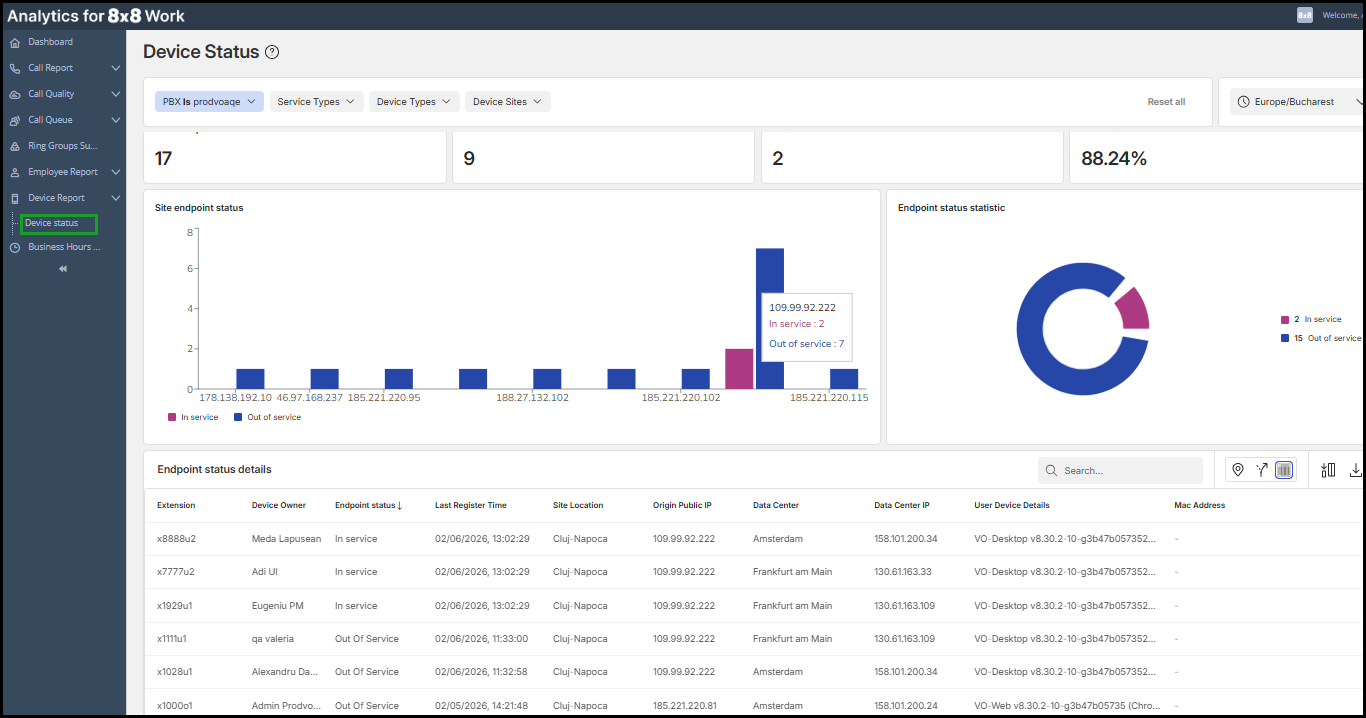
The Device Status dashboard provides real-time information for all endpoint devices in your 8x8 cloud phone system.
It includes:
- Summary tiles: Total endpoints, total sites, in-service devices, and out-of-service devices
- Site endpoint status: A visual chart showing device availability per site.
- Endpoint status statistic: A visual summary that shows the percentage of all endpoints that are currently in service or out of service.
- Endpoint status details table: A detailed list of individual endpoints, including status, timestamps, extensions, assigned users, site location, IP addresses, data centers, and device details. To learn more, see Glossary: Endpoint status details.
Glossary and metric definitions
Need help understanding Device Status fields and metrics? For detailed definitions and explanations, see Glossary: Endpoints status details.
To learn more, see Get Device Status Data.
New Call Quality Dashboard
The new Call Quality dashboard replaces the legacy Call Quality Trend and Call Quality Detail reports. It provides a simplified, modern experience for monitoring voice quality and identifying issues across the organization.
Metrics have been reorganized to ensure consistency across 8x8 products, giving users a familiar and intuitive reporting environment.
Benefits
- Unified reporting: Combines legacy reports into one dashboard for quicker insights.
- Modern user experience: Navigation and visuals align with 8x8 design standards.
- Faster troubleshooting: View consolidated and individual Mean Opinion Score (MOSMean Opinion Score provides a numerical measure of the quality of human speech at the destination end of the circuit.) data to identify call-quality issues.
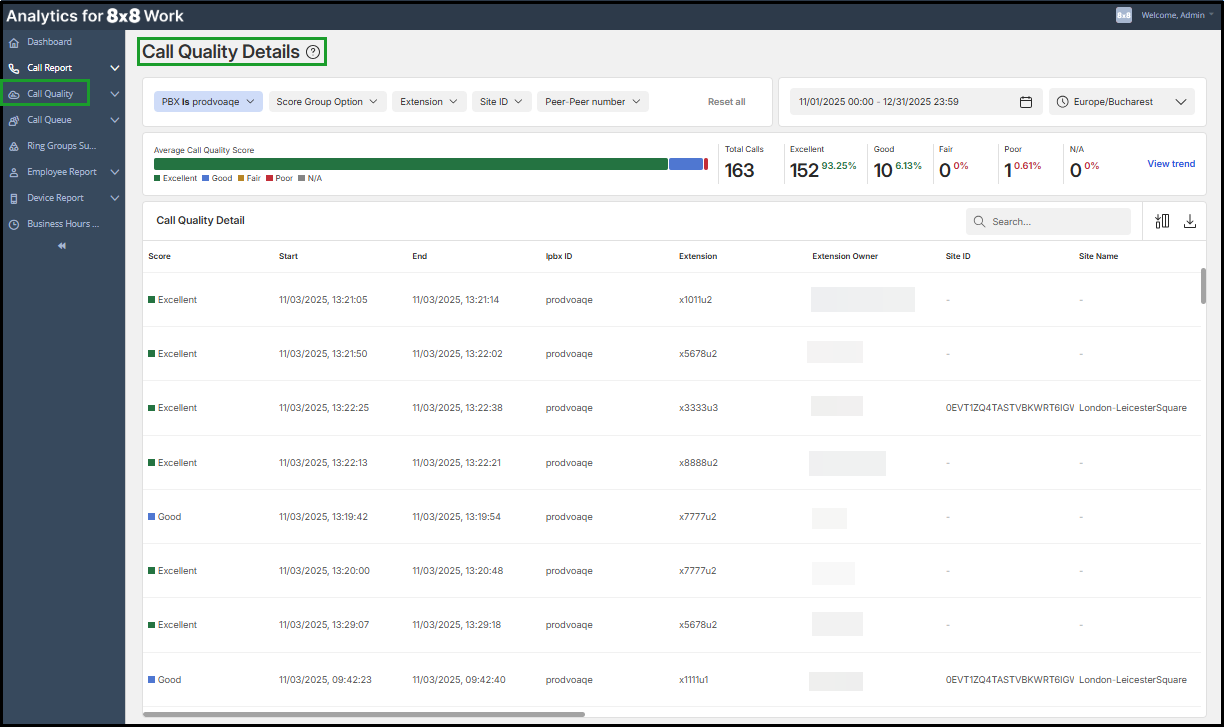
The Call Quality Details page provides MOS data in graphical formats to help you quickly drill down into specific calls and address persistent quality concerns.
Features
- Analyze call quality trends and generate related reports.
- Review voice quality scores to ensure good audio quality and balanced call volume.
- View data on voice quality, consolidated or for individual calls, and analyze how to resolve persistent issues that show up.
-
Filter by PBX, Score Group Option, Extension, Site ID and Peer-Peer number.
- Search bar to quickly locate specific calls.
Access the Call Quality dashboard
The Call Quality dashboard is available in Analytics for 8x8 Work.
To access the new dashboard:
- Log in to Analytics for 8x8 Work.
- From the left menu, select Call Quality
 .
. - Use the calendar and time selectors to choose your desired date and time range. To learn more, see Customize the report settings.
-
Filter the data by PBX, Score Group Option, Extension, Site ID and Peer-Peer number. To learn more, see Customize the dashboard.
Note: Click Export this file in the upper-right corner of the Call Quality Detail table to download the data to CSV
Access the Call Quality Trend board
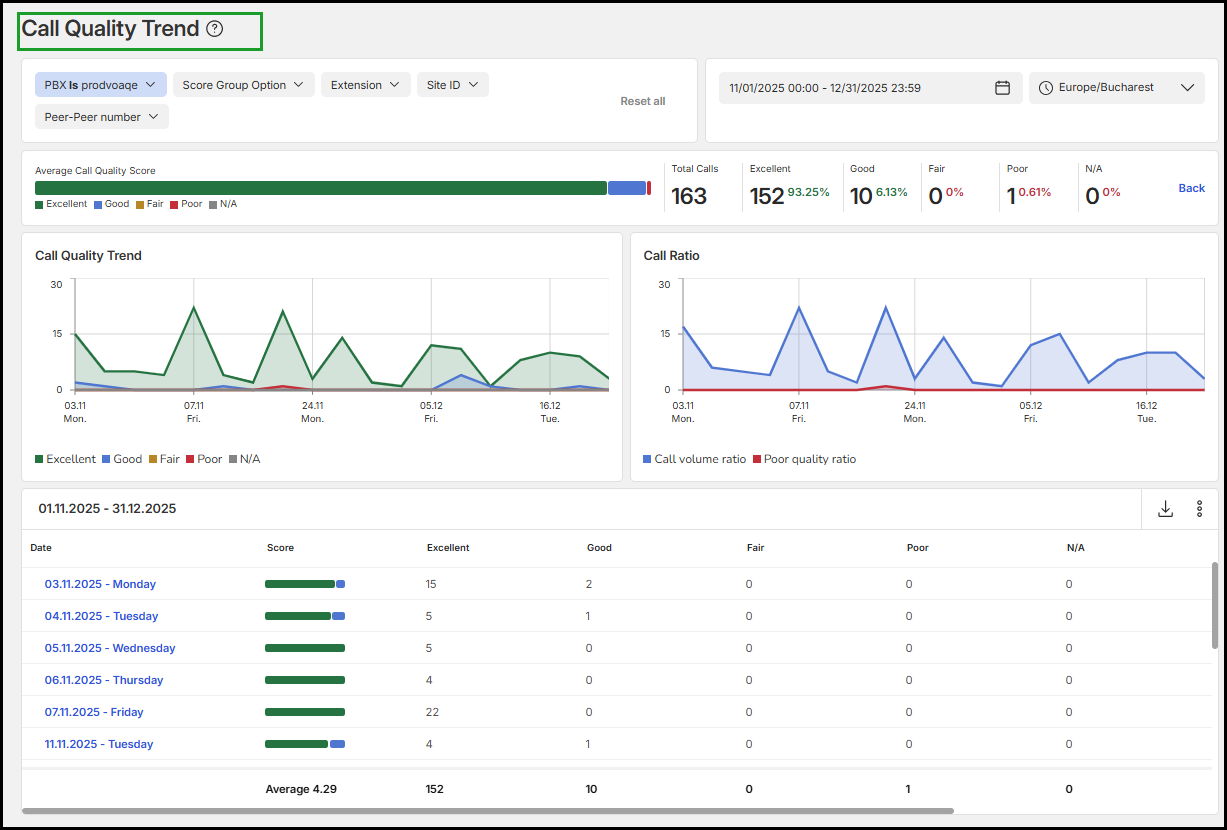
Use the Call Quality Trend board to view MOS scores and call ratios over time. It helps you monitor long-term changes and pinpoint when quality dips occur.
Features
- Data visualization: View diagrams for Call Quality Trend and Call Ratio, alongside Average call quality and Total calls, based on Mean Opinion Score (MOS).
- Performance categorization: See a breakdown of call performance across quality levels: Excellent, Good, Fair, Poor, and N/A.
- Flexible filtering: Narrow results using filters for PBX, Score Group, Extension, Site ID, and Peer-Peer number.
- Exportable data: Download report results in CSV or Excel format for deeper analysis and archiving.
To access the Call Quality Trend board:
- Open the Call Quality Dashboard.
- In the upper-right corner, click View trend.
- Use filters (PBX, Score Group Option, Extension, Site ID and Peer-Peer number) and date selectors to refine the view. To learn more, see Customize the dashboard.
The Call Quality Trend page displays line charts of call quality trends and ratios over time, and a table showing daily call breakdowns by quality level.
Note: Click Export this file in the upper-right corner of the Call Quality Trend table to download the data to CSV .
 .
.
Access the Endpoint voice quality report
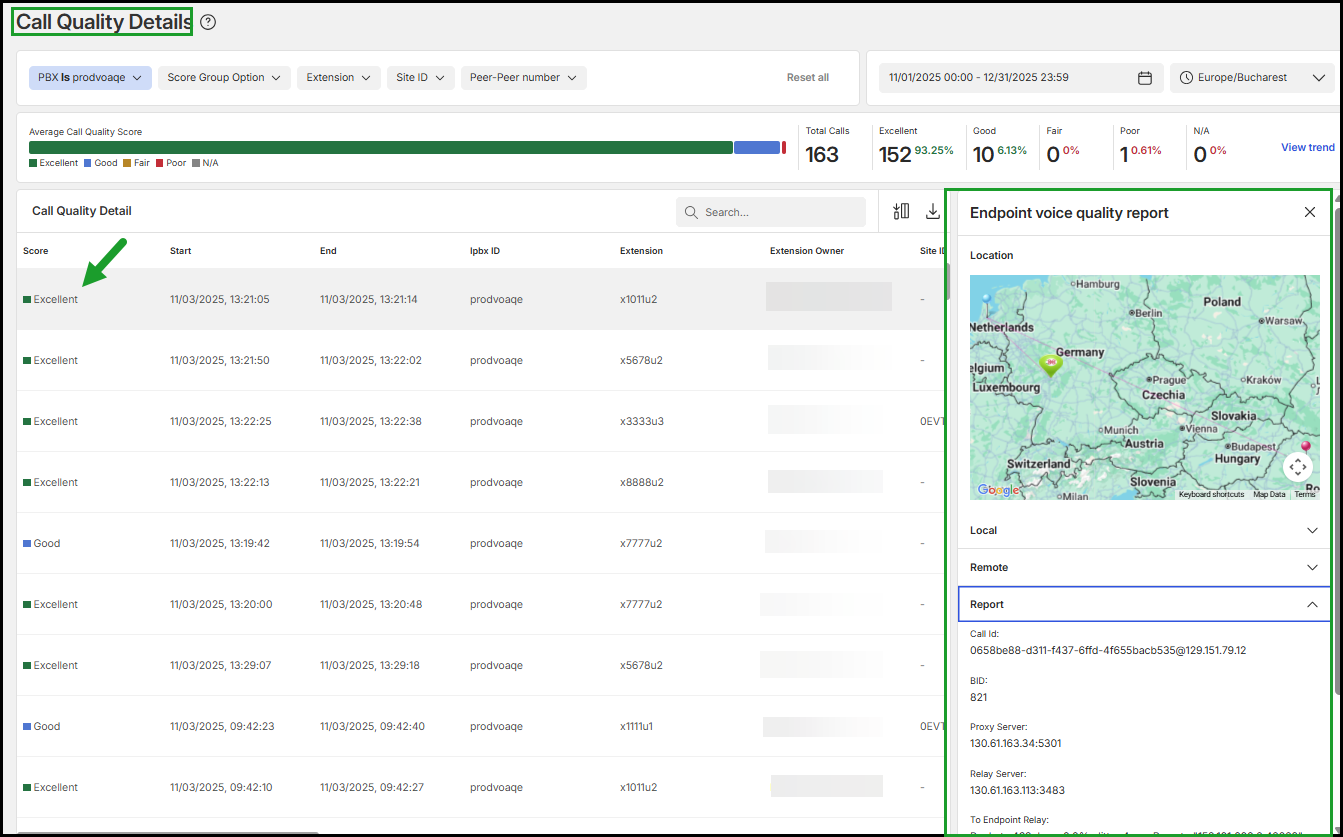
Drill down into individual calls to understand local and remote performance.
To access the Endpoint voice quality report:
- Open the Call Quality Dashboard..
- Go to the Call Quality Detail table.
- Click a specific call entry to open the Endpoint voice quality panel.
This view presents voice quality data for individual calls, grouped into the following categories:
- Local: Displays local call information: Timestamp, Call Id, Session desc, From, To, Endpoint, Jitter, Packet loss, Latency, Burst gap loss, PublicIpAddr, LocalAddr, RemoteAddr, QualityEst
- Remote: Displays call route information: Start time, Call Id, Session desc, From, To, Endpoint, Jitter, Packet loss, Latency, Burst gap loss, PublicIpAddr, LocalAddr, RemoteAddr, QualityEst
- Report: Displays server and network information: Call Id, BID, Proxy Server, Relay Server, To Endpoint Relay, To Endpoint Time, From Endpoint Relay, From Endpoint Time
Customize the dashboard
You can customize the dashboard to highlight the most relevant metrics.
Options include:
- Filters: PBX, Score Group Option, Extension, Site ID and Peer-Peer number
- Date and time range: Preset or custom selection
- Column selection: Show or hide specific metrics, reorder columns
- Time zone: Adjust the display to your preferred zone
- Export: Save filtered views as CSV or Excel
To learn more, see Customize the dashboard.
Glossary and metric definitions
Need help understanding call report fields? For a full explanation of call report metrics, see Call Quality dashboard - Glossary.
To learn more, see Get Call Quality Details.
Previous Releases
To learn more about the features and enhancements introduced in the previous releases, click here.


