Get call queue metrics
Note: Available for Analytics for 8x8 Work Supervisors only.
Call Queues dashboard-overview
The Call Queues dashboard provides a unified view of queue performance, agent activity, and call records in Analytics for 8x8 Work.
The Call Queues dashboard helps supervisors:
- Monitor real-time queue activity
- Analyze historical queue performance
- Track agent activity
- Access detailed call records
It replaces the following legacy reports:
- Queue Board
- Queue Listing
- Queue Detail
- Queue Call Data
The dashboard combines real-time metrics, historical analytics, and call-level data in a single interface, allowing supervisors to monitor queue service levels and analyze agent performance more efficiently.
Supervisors can quickly answer key operational questions such as:
- How many calls were received by the queue and answered by agents
- How many calls are currently in progress
- How many calls each agent handled during the selected period
Note: The dashboard uses queue-specific counting logic. Metrics should not be reconciled with other reports .
Capabilities
- Unified queue monitoring: View real-time and historical queue metrics in one dashboard.
- Real-time and historical queue metrics: Monitor live queue activity and agent availability.
- Multi-queue comparison: Compare multiple queues simultaneously.
- Agent and call-level insights: Analyze agent performance and individual call records.
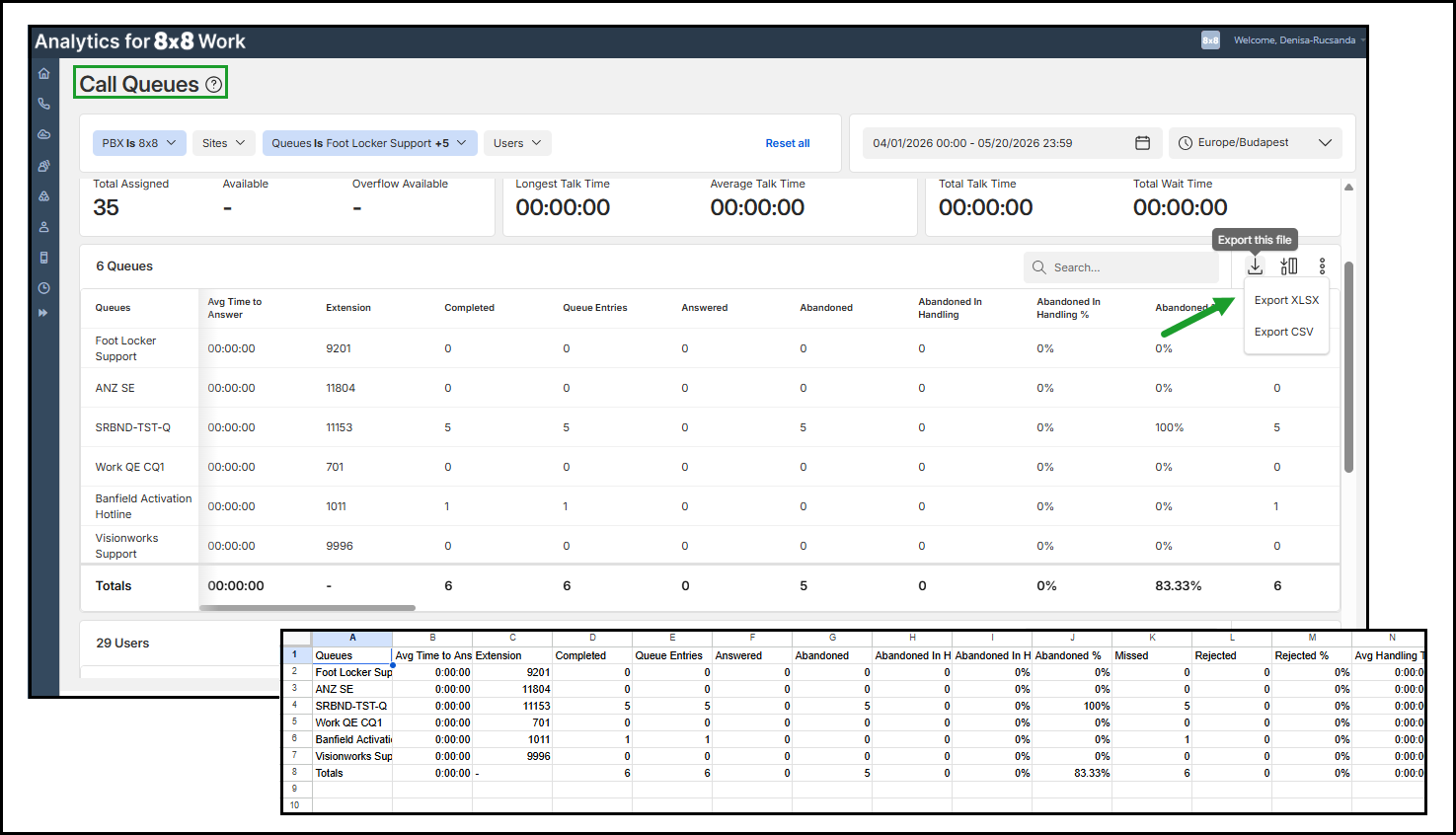
- Data export: Download report data in CSV or Excel format
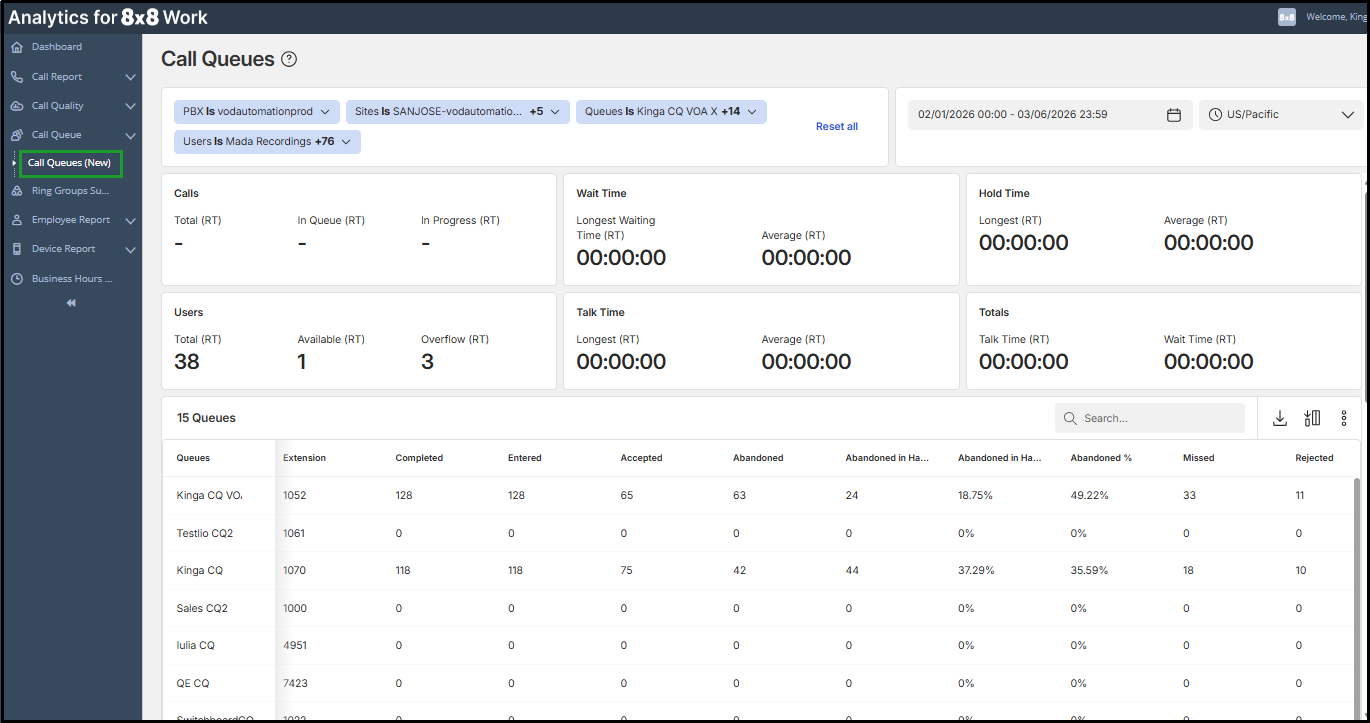
 Dashboard layout
The dashboard contains the following components.
- Widget tiles: Display real-time metrics for selected queues.
-
Queues table: Provides queue-level statistics such as:
-
calls waiting
-
calls in progress
-
wait time
-
answered calls
-
-
Users table: Displays user performance metrics such as:
-
calls accepted
-
talk time
-
hold time
-
wrap-up time
-
- Call records view: Selecting a queue allows you to drill down into detailed call records.
Differences from the Call Queues legacy reports
The new report consolidates functionality from several legacy reports into a single interface.
The following table shows where each legacy report feature is now located.
| Legacy report | Where to find it in the new report | Description |
|---|---|---|
| Queue Board | Widget tiles at the top of the report |
These widget tiles provide a quick overview of key queue metrics. For more information about their behavior, see Real-time widgets. |
| Queue Listing | The Queues table with real-time and historical metrics |
The updated Queues report provides even more historical and live metrics to monitor queue performance. For more details, see Real-Time vs Historical Metrics in the Queues Table. |
| Queue Detail | Distributed across the Widgets, Queues table, and Users table |
Use the Queue filter to focus the report on a specific queue. Use the calendar (date and time) selector to switch between live (real-time) and historical views:
|
| Queue Call Data | The queue drill-down view is accessible from the Queues table |
The data from Queue Call Data legacy report is now integrated within each queue in the Queues table. Selecting a queue allows you to drill down and download call data for that queue. This view allows you to download all associated call data for the selected queue. For more details, see Access the <queue> call data report |
Navigate the Call Queues dashboard
The Call Queues dashboard includes several tools for analyzing queue performance.
- Filters: Filter results by PBXPrivate Branch Exchange—a private telephone network used within a company., site, queue, or user.
- Date and time selectors: Choose the reporting period and time zone.
- Widgets: View real-time metrics at the top of the dashboard.
- Queues table: Displays queue statistics and service metrics.
- Users table: Shows performance data for users associated with the selected queues.
Important! To populate the Users table, you must select the queue the user is a member of.
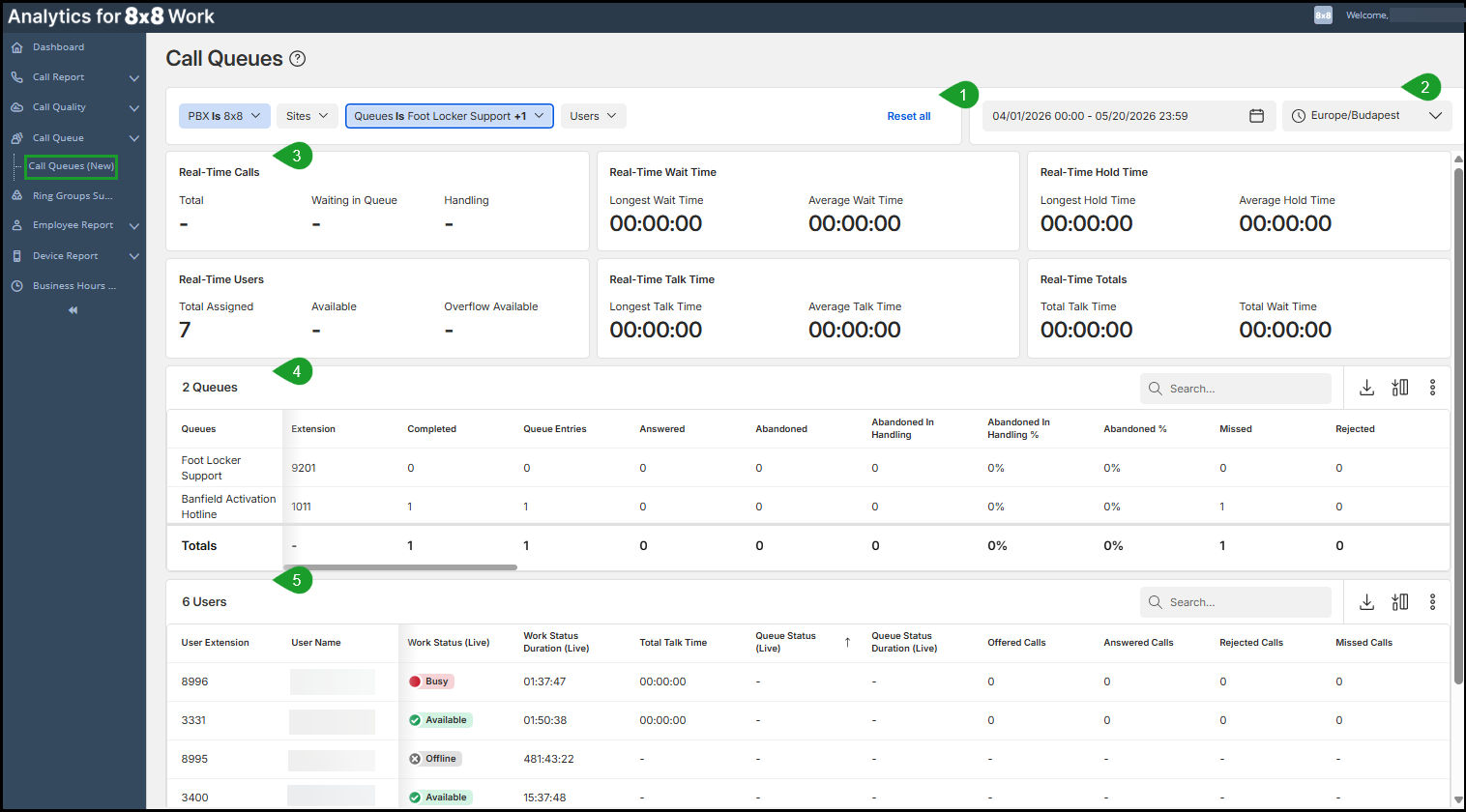 Real-Time Widgets
The Widget tiles show real-time metrics for the chosen queues. You can view important queue activity at a glance.
The widgets display metrics such as:
- Real-Time Calls – total calls, calls waiting in queue, and calls in progress (handling)
-
Real-Time Wait Time – longest wait time and average wait time
Note: The Real-Time Wait Time is no longer retained after the call leaves the Waiting stage.
- Real-Time Hold Time – longest hold time and average hold time
- Real-Time Users – total users, available users and overflow users
- Real-Time Talk Time – longest talk time and average talk time
- Real-Time Totals – total talk time and total wait time
To learn more, see Glossary: Real-time widgets metrics.
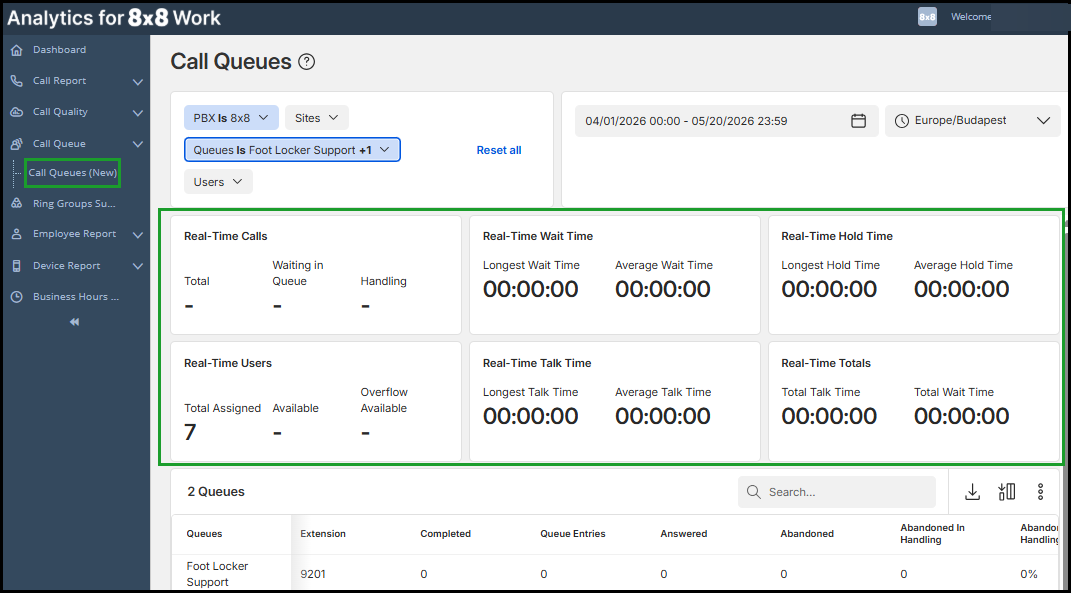
General behavior of real-time widgets
Scope
By default, all metrics include all queues within the selected PBX. Applying a Sites or Queues filter updates the widgets to display results only for the selected sites or queues.
Real-time data display
All Widget tiles display live activity, reflecting the current state of calls and users regardless of the selected date range.
Live call time accumulation — Wait, Handling, Hold and Totals
For active calls, time-based metrics accumulate while the call remains in that state until the call ends.
For example:
- A call waits 12 seconds in the queue.
- When the call moves to Talking, the wait time widget will reset to zero.
- Talk time then begins increasing.
This provides a live view of how long calls are spending in each phase.
Why values can change
Because time-based values depend on active calls, they can increase gradually or change suddenly. Values may increase when a long-running call enters scope or changes state and decrease when one or more calls end and drop out of the active set.
When there are no active calls in the queue(s):
The Real-Time Calls widget shows “—”
Phase totals (Wait, Handling, Hold, and Totals) show “0”
Aggregation
When multiple queues or users are selected:
- Totals or counts (for example, Total Calls or In Queue Calls) are summed across all selected queues.
- Longest … time (Wait/Talk/Hold time metrics show the maximum time recorded for a single call across all selected queues.
- Average … time (Wait/Talk/Hold time) metrics show the average time for the currently active calls relevant to that metric.
Units
Durations are displayed in hh:mm:ss format and calculated in seconds.
Glossary: Real-time widgets metrics
| Metric name | Description |
|---|---|
| Total |
The total number of currently active calls across the in-scope queue(s), regardless of the call’s current stage (like waiting, being handled, on hold, etc.). Note: This count includes calls that are still in progress and continues to reflect the call as active until the call is completed. |
| Waiting in Queue |
The number of active calls currently in the WAITING status, such as callers who are in the queue and have not yet been connected to an agent. |
| Handling |
The number of active calls currently in the Handling status. Handling represents the phase when a call is actively managed by a human agent, either while talking to the caller or when the call is on hold.
Purpose: To measure the duration and volume of calls that involve real human engagement, not automated or voicemail activity. |
| Total Assigned |
The total number of users assigned to the in-scope queue(s), including both primary assignments and secondary (overflow) assignments |
| Available |
The number of users assigned to the queue(s), primary and overflow, who are logged in to the queue and whose Queue Status is Available, meaning they are ready to receive a new queue call. Users are not counted as Available if their Queue Status is Handling, Offering, Paused, Wrap-up, Busy elsewhere, DND |
| Overflow Available |
The number of secondary (overflow) users assigned to the selected queue(s) who are logged in to the queue and whose Queue Status is Available (ready to receive new queue calls). Secondary (overflow) users are configured in 8x8 Admin Console as secondary agents for a queue. Each overflow user is counted once, even if they are assigned as an overflow agent to multiple selected queues.
|
| Longest Wait Time |
The longest time any call has spent waiting in the queue among the calls that are currently in the Waiting state in the selected queue(s). The value reflects the call with the highest waiting duration. Once a call leaves the Waiting state (answered, abandoned, or otherwise routed), it no longer contributes to this metric. |
| Average Wait Time |
The average time calls have spent waiting in the queue across all calls that are currently in the Waiting state in the selected queue(s). This value updates continuously while calls remain in Waiting and stops contributing once a call is answered, abandoned, or otherwise leaves the Waiting state. |
| Longest Hold Time | The longest time any currently active call has been on hold in the selected queue(s). The value reflects the call with the highest On Hold duration. |
| Average Hold Time | The average time calls have spent on hold for those calls that are currently in the On Hold status in the selected queue(s). |
| Average Talk Time | The average time users have spent talking to callers for calls that are currently in the Talking status in the selected queue(s). |
| Longest Talk Time | The longest talk duration among calls that are currently in the Talking status in the selected queue(s). The value reflects the call with the highest Talking duration. |
| Total Wait Time Total |
The combined waiting time of all calls that are currently in the Waiting state in the selected queue(s). This value updates continuously while calls remain in Waiting and stops contributing once a call is answered, abandoned, or otherwise leaves the Waiting state. |
| Talk Time | The combined time agents have spent talking to callers across all calls that are currently in the Talking status in the selected queue(s). |
Real-Time vs Historical metrics in the Queues table
The Queues table displays two types of metrics:
Real-Time (live) metrics
- Show the current state of queues (for example: how many calls are waiting, how many are in progress, how many agents are available).
- These values update continuously as calls and agent statuses change.
- Real-time data are marked with (Live)
Historical metrics:
- Summarize queue activity during the selected reporting period (for example: how many calls were offered, answered, and abandoned, and average answer time).
- These values only change when you adjust the date range or filters.
- These values will increase after a live call ends, so that you might have an active call waiting for 5 minutes, but these 5 minutes will be added to the Waiting Time once the call completes
You can often identify the metric type by its name.
- Real-Time metrics typically include terms such as: live, ongoing, waiting now, available now, in progress
- Historical metrics usually reference totals, averages, longest, counts within the selected reporting period.
Note: Real-time widgets display live queue activity regardless of the selected date range.
Access the Call Queues dashboard
The Call Queues dashboard is accessible in 8x8 Analytics for 8x8 Work.
To access the new dashboard:
- Log into 8x8 Analytics for 8x8 Work.
- Go to Call Queue
 > Call Queues (New).
 -
Select the date range and time zone. To learn more, see Customize the report settings.
-
Apply filters for PBX, sites, queues, or users. To learn more, see Customize the dashboard view.
The dashboard then displays real-time and historical queue metrics based on the selected filters.
You can:
- View real-time data under widgets. For details, see Real-time widgets.
- View high-level insight into queue performance across your organization. For details, see Real-Time vs Historical metrics in the Queues table.
- View Users available for the selected queues. For details, see Real-Time vs Historical metrics in the Queues table.
- View detailed queue call records for a selected queue. For details, see View detailed call records for a queue.
Important!
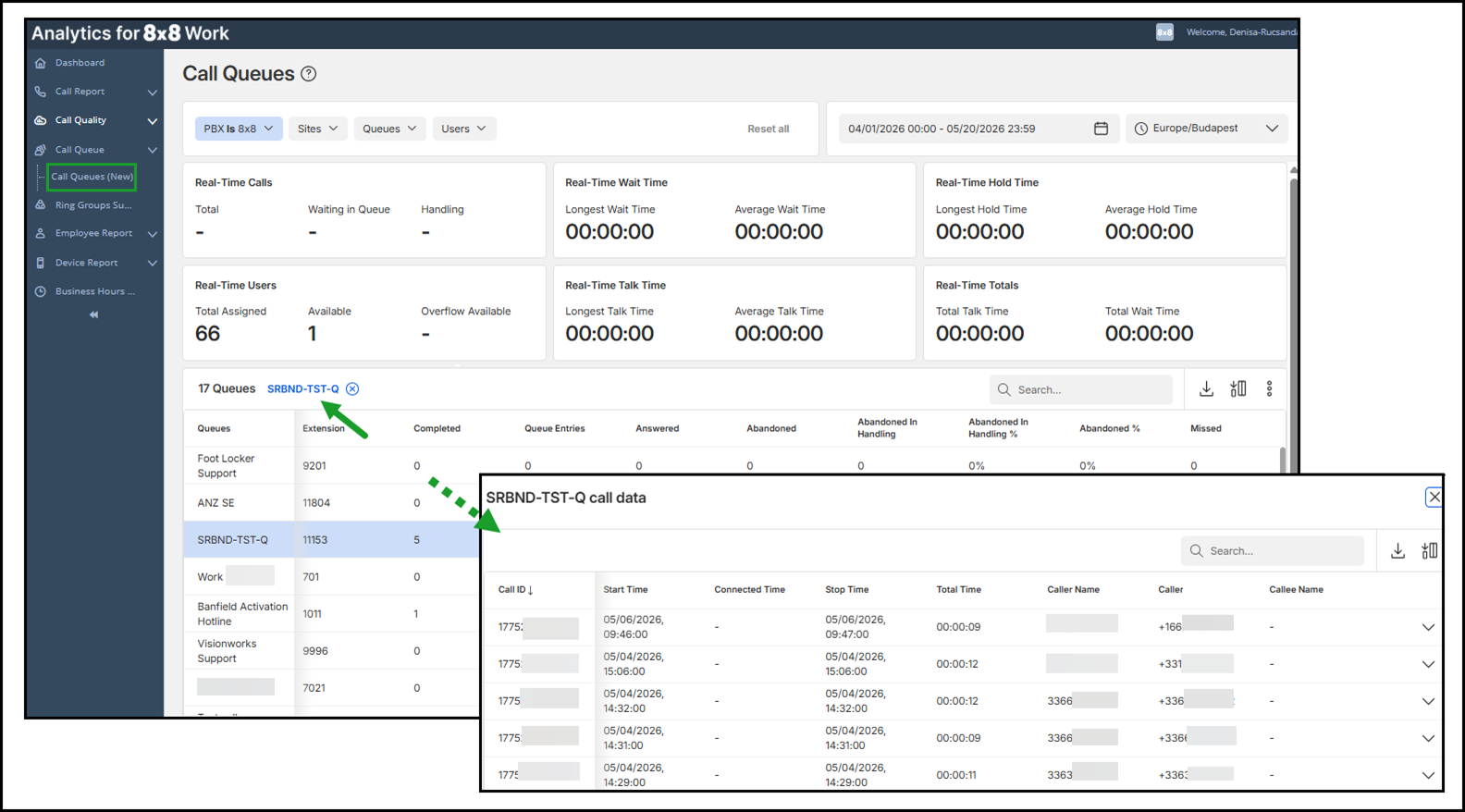
- To monitor live calls or see a detailed call history (CDRCall Detail Record includes call details such as point of origin,end point, call direction, call duration, and more.) for a queue, you have to select a specific queue in the Queues table, then click the <queue name> (displayed in blue) in the upper-left Queues table header.
- To populate the Users table, you must select the queue the user is a member of. Filtering users without selecting a queue will not populate the live metrics.
To view all the available metrics, see:
View detailed call records for a queue
The <queue name> Call Data report for a specific queue provides detailed records of all associated calls. From this report, you can access further details (drill down) and download the call data for the selected queue.
- In the Queues table, select the queue you want to analyze.
- Click the <queue name> shown in blue in the table header.
This opens the <queue name> Call Data report, where you can:
- View detailed call records
- Analyze call lifecycle events
- Download call data
Customize the dashboard view
You can adjust filters, columns, and views to prioritize specific metrics in Queues, Users, and <queue> call data tables.
To find more about how to customize a dashboard in Analytics for 8x8 Work, see Customize report settings.
How filters affect dashboard data
Filters determine which queues, users, and calls are included in the dashboard. Your selection is saved for your next session.
The filters are located at the top of the Call Queues dashboard.
- PBX: Filter the report by PBX. If only one PBX is available, it is selected by default.
- Sites: Selecting a site displays data only for queues associated with that site(s).
- Queues: Selecting a queue limits metrics to that queue(s).
- Users: Selecting users without selecting a queue may result in empty user metrics.
Note: To view live user activity, first select the queue that the user belongs to.
- Additional tool:
- Reset all: Restore default filter settings with one click. You can reset your filter criteria either for each filter individually or all at once with a single click.
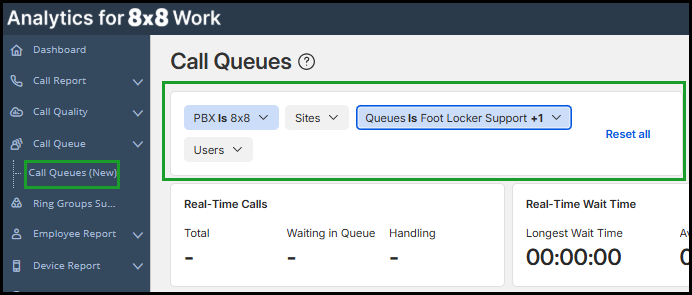
Adjust date and time zone
- Use the calendar (date and time) selector to choose the reporting date and time range. You can select day, week, month, or a custom range.
- Use the time zone selector in the upper-right corner to display accurate local operational time.
Select visible columns
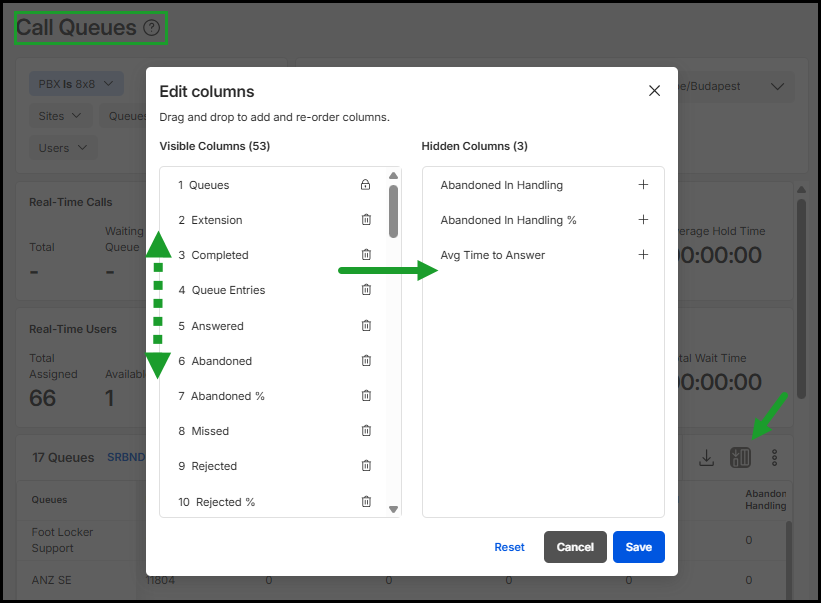
You can customize column visibility in the Queues, Users or <queue> call data table.
- In the upper-right corner of the call table, click the Edit columns
 icon.
icon. - Drag metrics between Visible and Hidden columns.
- Reorder columns by dragging them up or down.
- Add or remove a column by clicking + or
 next to it.
 - Click Save to apply changes, or Reset to restore the default view.
Note: You can cancel your changes or reset the column visibility at any time.
Search for specific queues, users and queue calls
- Use the Search
 bar in the upper-right corner of your table to easily find a queue, user or a queue call data.
 - In the Queues table, search by queue name.
- In the Users table, search by user name.
- In the Queue call data table, search by caller/callee information (for example, name or extension).
To clear a search, clear the search bar or refresh the page.
Sort column values
Sort data in any column alphabetically or numerically:
- Click the arrow
 icon in the column header to reorder values.
Show or hide metric totals
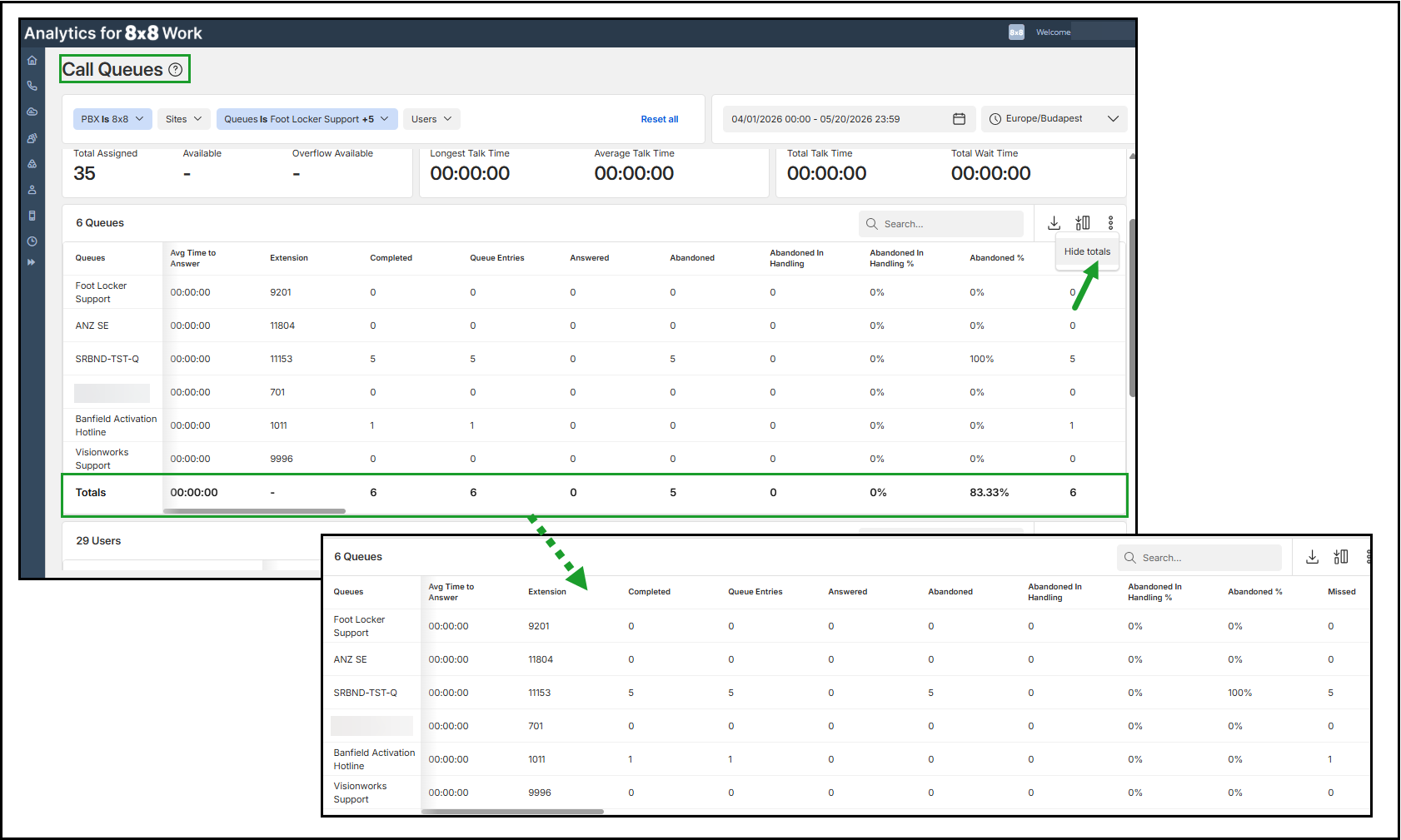
Click Show more  > Hide totals in the upper-right corner of the Queues or Users list to remove or add back the Totals row shown at the bottom of the report.

 Limitations
While this dashboard improves reporting for 8x8 Work, it does not replace Contact Center dashboards available in higher-tier X Series licenses.
- Compared to Contact Center dashboards, the Call Queues dashboard:
- Offers fewer visualizations
- Does not support saving or sharing multiple custom views
- Uses global filters instead of widget-level configuration
- Does not support a public shareable link. Access requires a login, so it cannot be shared publicly for use cases like wall boards.
- Contact Center dashboards remain the most advanced option for complex queue reporting.
Differences between per-user counts and totals in the Users table
The Users table in the Call Queues dashboard displays call activity broken down by individual user. . Understanding how each counting method works helps supervisors interpret metrics accurately and identify where individual agents may need support.
How calls are counted per user
In the Users table, the Offered Calls, Answered Calls, Rejected Calls, and Missed Calls columns count call attempts for each individual user rather than unique calls. A single inbound call may interact with the same user more than once during its lifecycle.
For example, a call may be offered to a user more than once:
- The call is offered to a user.
- The user does not pick up.
- The call moves on to another user or returns to the queue.
- The call is offered to the same user again.
Each of these interactions is counted as a separate attempt for the affected user. This means:
- Offered Calls count every time a call was presented to the user, including calls that rang at the user's device and calls received as a direct transfer that connected without an alerting (ringing) phase. Repeated offers of the same call are each counted separately.
- Answered Calls count every time the user picks up a call, including the same call answered after a previous missed or rejected attempt.Rejected Calls
- Missed Calls count every time a call was presented to the user and the user did not pick up, whether because the user let it ring without answering or because the caller hung up while the user's phone was still ringing. The missed call is recorded for the user regardless of whether another user later answered the same call.
Why per-user metrics count attempts
Per-user metrics reflect each user's individual responsiveness: the key question at the user level is how the user responded when allowed to handle a call.
- If a call is offered to a user and they do not pick up, that is a missed opportunity for that user, even if another user successfully handled the same call.
- If a call is offered to a user three times across the day and they missed it each time, that represents three missed opportunities, not one.
This counting approach allows supervisors to evaluate user performance, coaching opportunities, and individual reliability based on the offers each user actually received.
Why row-level numbers may also appear inconsistent
Within a single user's row, Offered Calls does not always equal Answered + Rejected + Missed. A call may ring at a user's device and then be answered by another user, or routed elsewhere by the system, before the offer to this user resolves into a clear missed, rejected, or answered outcome. In some routing scenarios, the offer ends without being categorized as missed for this user, even though it was counted as offered.
These characteristics reflect how per-user counting works in the Call Queues dashboard. Supervisors should treat per-user metrics as directional indicators of individual responsiveness.
Quick reference
|
What you are looking for |
What it counts |
|---|---|
| Per-user row values | Attempts (per user) |
| Totals row values | Unique calls (across all users) |
| Sum of a column | Total attempts across all users, usually higher than Totals row |
| Totals: Answered + Rejected + Missed | Can exceed Totals: Offered (the same unique call can fall in multiple outcome cells |
| Queue-level metrics | The final outcome of each unique call |
For an overview of the dashboard , see Call Queues dashboard overview.
For queue-level metric definition, see Glossary: Users metrics.
Glossary: Queues metrics
The Queues table displays both Live( real-time) and historical metrics.
Live (Real-Time) Queues metrics
| Metric | Description |
|---|---|
| Available users (Live) | The number of users assigned to the queue(s) (primary and overflow) who are logged in to the queue and whose Queue Status is Available (ready to receive new queue calls). This value updates in real time as agent status changes (like going into DND) and as live queue activity changes. |
| Ongoing Avg Handling Time (Live) |
The real-time average handling duration for calls that are currently in progress in the selected queue(s). Handling time includes time spent Talking and On Hold (non-voicemail) and updates continuously while the calls are ongoing. |
| Ongoing Avg Talk Time (Live) |
The real-time average talk duration across all calls that are currently in the Talking state in the selected queue(s). This value updates continuously while calls are ongoing and includes only time connected to a live agent (no voicemail/automated time). |
| Ongoing Avg Waiting Time (Live) |
The real-time average queue wait duration for calls that are currently being offered to agents in the selected queue(s). This value updates continuously while those calls remain in the Waiting state. |
| Active Roster (Live) |
The number of primary and secondary (overflow) users who are logged in to the queue and eligible to receive queue calls. Includes users whose Work presence is Available, Busy, Away, or Appear Offline (Invisible). |
| Active Overflow Roster (Live) |
The number of secondary (overflow) users who are logged in to the queue and eligible to receive queue calls. Includes users whose Work presence is Available, Busy, Away, or Appear Offline (Invisible) . |
| Active Primary Roster (Live) |
The number of primary users who are logged in to the queue and eligible to receive queue calls. Includes users whose Work presence is Available, Busy, Away, or Appear Offline (Invisible) . |
| Logged-In Overflow Users (Live) | The number of secondary (overflow) users who are currently logged in to the queue, regardless of their current status or availability. |
| Logged-In Primary Users (Live) | The number of primary users who are currently logged in to the queue, regardless of their current status or availability. |
| Calls In Handling (Live) |
The number of calls that are currently being handled by users in the selected queue(s). A call is counted as Handling when it is connected to a live user (Talking) or placed On Hold (non-voicemail). |
| Logged Out & DND Users (Live) | The number of primary and secondary (overflow) users who are currently not eligible to receive queue calls because their status is Offline, Logged out or DND. |
| Logged Out & DND Overflow Users (Live) | The number of secondary (overflow) users whose current status is Offline, Logged out or DND, meaning they won’t be offered queue calls. |
| Calls On Hold (Live) | The number of calls that are currently in the On Hold state in the selected queue(s). |
| Ongoing Total Hold Time (Live) |
The combined time spent on hold across all calls that are currently in the On Hold state in the selected queue(s). This value updates continuously while calls remain on hold. |
| Overflow Users (Live) |
The number of overflow (secondary) users assigned to the selected queue(s) in 8x8 Admin Console. This is a roster/configuration metric; it does not depend on whether users are logged in/out of the queue and does not change based on live calls or user status changes. Users are counted once, even if the same user is configured as overflow in multiple selected queues. As a result, the Totals row also counts each overflow user only once. |
| Overflow Users in Wrap-Up (Live) |
The number of secondary (overflow) users currently in the Wrap-up state. Wrap-up starts automatically after a call ends (regardless of who hangs up) and lasts up to 75 seconds max (configurable in 8x8 Admin Console). While a user is in Wrap-up, no new queue calls are offered to them. |
| Primary Users in Wrap-Up (Live) |
The number of primary users currently in the Wrap-up state. Wrap-up starts automatically after a call ends (regardless of who hangs up) and lasts up to 75 seconds max (configurable in 8x8 Admin Console). While a user is in Wrap-up, no new queue calls are offered to them. |
| Calls Talking (Live) | The number of calls that are currently in the Talking state in the selected queue(s), meaning they are connected to a live user (not voicemail) |
| Ongoing Total Talk Time (Live) |
The combined talk duration across all calls that are currently in the Talking state in the selected queue(s). This value updates continuously while calls remain in Talking and includes only time connected to a live user. |
| Active Calls (Live) |
The total number of calls currently associated with the selected queue(s), regardless of their current phase/status. This includes calls that are waiting, being offered, being handled (talking/on hold), and voicemail. |
| Ongoing Total Handling Time (Live) |
The combined handling duration across all calls that are currently in the Handling phase in the selected queue(s). Handling includes time in Talking and On Hold (non-voicemail). This value updates continuously while calls remain in handling |
| Calls Waiting (Live) | The number of calls that are currently waiting in the queue (state: Waiting) in the selected queue(s). |
| Ongoing Total Wait Time (Live) | The combined waiting duration across all calls that are currently in the Waiting state in the selected queue(s). This value updates continuously while calls remain waiting. |
| Users in Wrap-Up (Live) |
The number of primary and secondary (overflow) users who are currently in the Wrap-up state. While in Wrap-up, users are not offered new queue calls. |
| Totals |
The bottom-line summary for all filtered queues. This row aggregates the data across your selection. Absolute numbers (for example, Entered, Accepted) are displayed as a sum total. Performance metrics (for example, Abandoned %, Average Talk Time) are dynamically recalculated based on the combined total volume, rather than just averaging the column, to ensure accurate reporting |
Historical Queues metrics
| Metric | Description |
|---|---|
| Extension | The extension number associated with the queue. |
| Completed |
This metric increments only after the call is finished, even if it ended outside the queue Every completed call lands in exactly one of the following five outcome buckets: Completed = Answered + Missed + Abandoned + Diverted Use this formula to break down what happened to the calls that reached your queue. Note on the selected time interval (historical data):
As a result:
|
| Queue Entries |
The total number of unique inbound calls that entered the queue during the selected time period. This metric increments as soon as the call hits the queue (live), making it useful for real-time monitoring of incoming queue demand. Unlike Completed Calls, Queue Entries does not wait for the call to finish. It counts the call the moment it enters the queue. As a result, Queue Entries may temporarily be higher than Completed if calls are still in progress. |
| Answered |
The total number of unique inbound calls that were answered by a user in the queue during the selected time period. A call is counted as Answered when a user picks up and the call enters the Handling state. Includes calls where the user later transferred the call (cold or warm) to another destination, and calls where the caller hung up during handling — once the call has been answered, it remains classified as Answered regardless of what happens afterward. |
| Abandoned | The total number of calls that reached the queue but ended before being answered by an agent. This includes callers who hung up while waiting as well as calls abandoned while in voicemail. |
| Abandoned % |
The percentage of queue entries that were abandoned while the caller was still waiting (like before an agent answered). Calculated as: |
| Missed |
The total number of unique inbound calls that were offered to at least one user (the call rang at a user's device) but were not answered, during the selected time period. The call entered the Offering state at least once and never reached the Handling state. Includes calls that were offered to multiple users in sequence without being picked up, and calls that were offered to a user, not answered, and then routed by the system to voicemail or another destination. This metric counts calls where users had the opportunity to answer and did not. |
| Diverted | The total number of unique inbound calls that entered the queue and were routed to another destination by the system — such as voicemail, another queue, a ring group, or an external number — without ever being offered to any agent. The call never rang at any agent's device. This metric helps distinguish between calls lost due to agent behavior (Missed, Rejected) and calls the system routed away before any agent was involved, which typically indicates a capacity, staffing, or routing configuration issue. This metric is calculated after calls are completed, so ongoing calls are not included until they end. |
| Diverted% |
The percentage of queue entries that were diverted by the system without ever being offered to an agent. Calculated as: (Diverted ÷ Queue Entries) × 100 If Queue Entries = 0, the value is 0% |
| Avg Handling Time |
The average time agents spent handling calls during the selected time period. Handling time includes time spent Talking and On Hold (non-voicemail). The metric is calculated after calls are completed, so ongoing calls are not included until they end. |
| Avg On Hold Time |
The average time calls spent on hold during the selected time period. This metric is calculated after calls are completed, so ongoing calls are not included until they end. |
| Avg Talk Time |
The average time agents spent talking to callers during the selected time period. This metric is calculated after calls are completed, so ongoing calls are not included until they end. |
| Avg Waiting Time |
The average time calls spent waiting in the queue before being answered or ending during the selected time period. This metric is calculated after calls are completed, so ongoing calls are not included until they end. |
| Avg Time to Answer |
The average number of seconds it takes for a call to be answered after it is offered to all the users in the queue.
Calculated as:
Only answered calls are included (missed/abandoned/rejected calls are excluded). |
| Total On Hold Time |
The total time of calls spent on hold during the selected time period. This metric is calculated after calls are completed, so ongoing calls are not included until they end. |
| Total Handling Time |
The total time users spent handling calls during the selected time period. Handling time includes time spent Talking and On Hold (non-voicemail). The metric is calculated after calls are completed, so ongoing calls are not included until they end. |
| Total Talk Time |
The total time users spent talking to callers for calls in the queue during the selected time period. This metric is calculated after calls are completed, so ongoing calls are not included until they end. Talk time includes only time when the call is connected to a live agent (like Talking), and excludes voicemail or automated interactions. |
| Total Waiting Time |
The total time calls spent waiting in the queue during the selected time period. This metric is calculated after calls are completed, so ongoing calls are not included until they end |
| Forwarded to Voicemail |
The total number of calls that were sent to voicemail during the selected time period. This includes both automatic forwarding (system rules) and manual transfers to voicemail. |
| Transferred to Queue | The total number of calls that were transferred to a queue during the selected time period — either back to the same queue or to a different queue. |
| Transferred to Ring Group | The total number of calls that were transferred to a ring group during the selected time period. |
Glossary: Users metrics
The Users table displays both Live( real-time) and historical metrics.
Live (Real-Time) Users metrics
| Metric |
Description |
|---|---|
| Work Status (Live) |
The user’s current presence/status in the app (not their queue status). This reflects the user’s overall availability in 8x8 Work. Possible statuses include: Available, Busy, DND, Away, Auto away, Offline, On call, and Invisible. |
| Work Status Duration (Live) |
The real-time duration showing how long the user has been in their current Work status such as Available, Busy, DND). The timer resets when the user’s Work status changes. |
| Queue Status (Live) |
The user’s current status within the selected queue, showing whether they can receive queue calls right now, are being offered a call, are handling a call, or are unavailable due to other activity. This status updates live as queue activity and user availability change. Statuses:
|
| Queue Status Duration (Live) |
The real-time duration showing how long the user has been in their current Queue Status (such as Available, Handling, Wrap-up) within the selected queue. The timer resets when the user’s Queue Status changes. |
| Queue Login Time (Live) |
This metric indicates the most recent date and time a user logged into the selected queue. It only reflects the latest login event, not a history of all login times. The behavior of this metric varies based on the queue type:
A "—" (dash) is displayed if the user has not yet logged into the queue. |
| Queue Logout Time (Live) |
This metric shows the most recent date and time a user logged out of the selected queue. It reflects only the latest logout event, not a history of all logout times. The behavior of this metric varies based on the queue type:
A "—" (dash) is displayed if the user is currently logged into the queue. |
| Ongoing Avg Talk Time (Live) |
The real-time average talk duration for calls that are currently in the Talking state with the selected user(s). This value updates continuously while calls remain in Talking. Totals row behavior: The Totals row shows the average ongoing talk time across the selected users. |
| Ongoing Avg Handling Time (Live) |
The real-time average handling duration for calls that are currently in the Handling phase for the selected user(s). Handling includes time in Talking and On Hold (non-voicemail). This value updates continuously while calls are ongoing. Totals row behavior: The Totals row shows the average ongoing handling time across the selected users. |
| Ongoing Handling Calls (Live) |
The number of calls that are currently in the Handling phase for the selected user(s). Handling includes calls in Talking or On Hold (non-voicemail). Totals row behavior: The Totals row counts unique ongoing calls (deduplicated), since a user cannot handle more than one queue call at the same time. |
| Total Handling Time (Live) |
The combined handling duration across all calls that are currently in the Handling phase for the selected user(s). Handling includes time in Talking and On Hold (non-voicemail). This value updates continuously while calls remain in handling. |
| Wrap-Up Calls (Live) |
The number of calls that are currently in the Wrap-up phase for the selected user(s). Wrap-up is the post-call state after a call ends, during which the user is not offered new queue calls. |
| Total Wrap-Up Time (Live) |
The combined time spent in Wrap-up across all calls that are currently in the Wrap-up phase for the selected user(s). This value updates continuously while calls remain in Wrap-up. |
| On Hold Calls (Live) | The number of calls that are currently in the On Hold state for the selected user(s). |
| Total Hold Time (Live) |
The combined time calls have spent on hold across all calls that are currently in the On Hold state for the selected user(s). This value updates continuously while calls remain on hold. |
| Talking Calls (Live) | The number of calls that are currently in the Talking state with the selected user(s), meaning the call is connected to a live user (not voicemail). |
| Total Talk Time (Live) |
The combined talk duration across all calls that are currently in the Talking state with the selected user(s). This value updates continuously while calls remain in Talking and includes only time connected to a live user. |
Historical Users metrics
| Metric | Description |
|---|---|
| User Extension |
The phone extension number assigned to the user. This value is configured and can be changed in 8x8 Admin Console. |
| User Name | The user’s name as it is shown in the system (the name used to identify the user in reports). |
| Total Talk Time | The total time the user spent talking to callers across all answered calls during the selected time period. |
| Offered Calls |
The total number of times calls were offered to the user during the selected time period. A single call may be counted multiple times if it is offered repeatedly to the same user (for example, after not being answered or re-queued). This metric reflects offer attempts, not unique calls. |
| Answered Calls |
The total number of calls the user answered from the queue during the selected time period. If the same call is redirected back to the queue and later offered again to the same user, it will be counted again if the user answers it again. |
| Rejected Calls |
The total number of times the user declined a queue call during the selected time period. If the same call is offered repeatedly to the same user and the user rejects it multiple times, each rejection is counted. |
| Missed Calls |
The total number of calls missed from the queue by the user during the selected time period. If the same call is offered repeatedly to the same user and is missed multiple times, each missed attempt is counted. |
| Avg Time to Answer | The average time a user takes to answer a call after it is offered to them. This is calculated as the total time from when calls are offered to the user until the user answers them, divided by the number of Answered Calls by that user in the selected period. Only answered calls are included; missed, abandoned, and rejected calls are excluded. |
| Avg Talk Time |
The average time the selected user(s) spent in the Talking state during the selected time period. This metric is calculated from completed calls, so it increments only after calls finish. |
| Avg Hold Time |
The average time the selected user(s) spent in the On Hold state during the selected time period. |
| Avg Wrap-Up Time |
The average time the selected user(s) spent in the Wrap-up state during the selected time period. The Wrap-up duration is configurable in 8x8 Admin Console, so the actual time may vary by queue setup. |
| Active Queue Time |
The total time the user spent actively processing queue calls. This metric represents the full life-cycle of the agent's involvement, consisting of: Ringing/Offered Time: The time the call rang at their extension. Talk Time: The live conversation with the caller (including any hold time). Wrap-Up: The time spent finishing notes or tasks immediately after the caller hangs up. Note: While in this state, the agent is considered 'occupied' and will not be offered new queue calls." |
| Answered % |
The percentage of call offers that were answered by the selected user(s) during the selected time period. Calculated as:
|
| Missed % |
The percentage of call offers that were missed by the selected user(s) during the selected time period.
Calculated as:
|
| Rejected % |
The percentage of call offers that were declined (rejected) by the selected user(s) during the selected time period.
Calculated as:
|
| Queue Name | The name of the queue that the user is a member of (based on the selected queue(s) in the report). |
| Queue Type |
Indicates how users are logged in to the queue, based on the Allow users to log in and log out from assigned queues the 8x8 Admin Console setting.
|
Glossary: Queue call data metrics
| Metric | Description |
|---|---|
| Call ID | A unique call identification number that identifies all legs of the original call. |
| Leg ID | Identifies the leg of a call with a hop number, such as 1 for direct, or 2 for a forwarded or transferred call for which this record refers to. |
| Start Time | Call starts as soon as caller goes off hook to dial. |
| Answer Time | The time when the call is answered. |
| Stop Time | The time the first party disconnects the call. |
| Talk Time | Duration of the live call (Stop Time minus Answer Time). |
| Caller | The phone number of the caller. |
| Callee | The phone number of the called party. |
| Last Re-Direct Number | The number of the last party that redirected the call. |
| Cause | Reason for call, listed as Normal, Redirected, Transfer, or Conference. |
| Status | Indicates status of a call as InProgress (dialing, talking, redirected) or completed (ended). |
| Direction | Indicates the direction of the call as incoming or outgoing. |
| Parent Call ID | Parent call identification number of a complex (transferred, forwarded, or conference) call. Searching by a Parent Call ID collects call details of all legs of a complex call. |
| Transfer To Call ID | Call Identification number that a call is transferred to. If a call is transferred to a second call, it has a different Call ID. The second call will have a TransferToCall ID with the value of the first call's Call ID. |
| Caller Name | Caller name of the extension from which the call originated. |
| Callee Name | Name of the called party, if available. |
| Caller Device ID | The device identifier unique to the device of caller. |
| Callee Device ID | The device identifier unique to the device of the callee, if available. |
| Caller Device Model | Device Model used by the caller in this leg of the call. |
| Callee Device Model | Device Model used by the callee in this leg of the call. |
| Caller ID | Transmitted caller number and/or name. |
| Missed | Indicates whether the call is missed (includes calls that reached voicemail and or abandoned ). |
| Abandoned | Indicates if the call is abandoned by the caller before it is answered or handled in this leg of the call (for this CDR). |
| Answered | Indicates if the incoming call was answered live (not including those answered by voicemail), or an outbound call that was answered (includes those answered by caller, auto attendant, and voicemail) for this leg of the call. In a multi-leg call, the first leg could be considered answered if answered by auto attendant. |
| Caller Service Name | Service Names include AutoAttendant, RingGroupService, ACDOperatorService, MasterSlaveService, OneNumberAccess, and ClickToDial. |
| Caller Service Type | Service Types include Custom, Virtual Extension, Voicemail, AutoAttendant, and CallParkExtension. |
| Callee Service Name | Service Names include AutoAttendant, RingGroupService, ACDOperatorService, MasterSlaveService, OneNumberAccess, and ClickToDial. |
| Callee Service Type | Service Types include custom, Virtual Extension, Voicemail, AutoAttendant, and CallParkExtension. |
| Last Re-Direct Type | Indicates if the call is a normal extension call, directed to a queue, or ring group. Possible values are 1 (normal extension), 3 (RINGGROUP), 4 (QUEUE), 5 (VIRTUALEXTENSION), 6 (MEDIASERVICE, like voicemail, Auto Attendant, or master-slave), and 7 (CALLPARKEXTENSION). |
| Caller Hold Duration | The length of time that the caller placed the call on hold. |
| Callee Hold Duration | The length of time that the callee placed the call on hold, if available. |
| Caller Disconnect On Hold | Indicates if the callee disconnected while on hold (listed as True or False). |
| Callee Disconnect On Hold | Indicates if the caller disconnected while on hold (listed as True or False). |
| PBX ID | Caller's phone system ID. |
| SIPSession Initiation Protocol—a telecommunication protocol for signaling and controlling multimedia communication sessions. Call ID |
SIP Call ID for this call. |
| Original Caller | Original caller for this leg of the call. |
| Original Callee | Original Called Call Queue. |


